This article contains affiliate links: if you buy through them we may earn a commission, at no extra cost to you. Learn more.
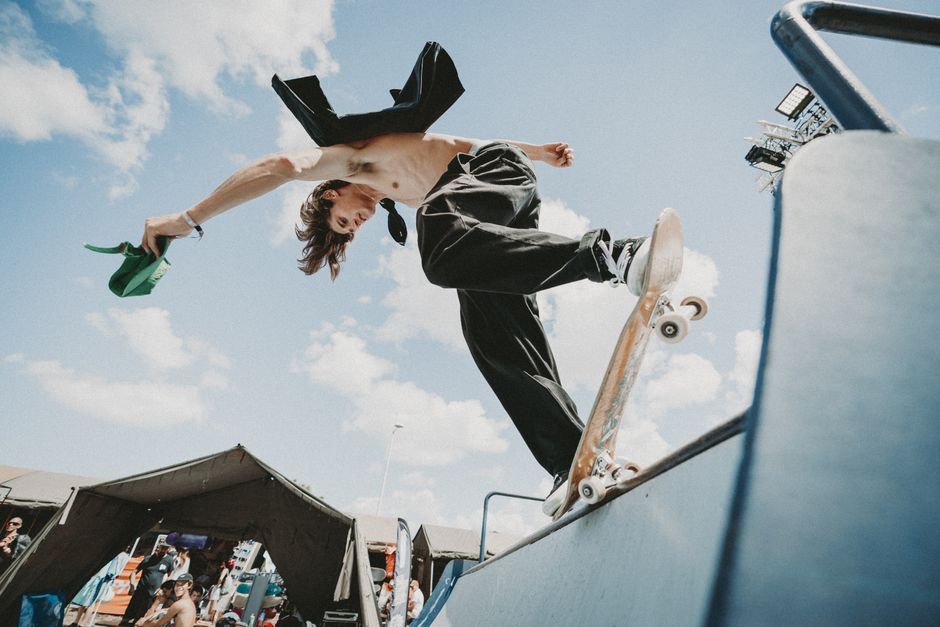
Saturday, 11 a.m. The concrete at the park is already warm, the speakers are on, and the session that was supposed to last an hour is heading into its fourth. Somebody’s been trying the same line on the hubba since noon and hasn’t eaten. Skateboarding doesn’t have halftime, but it has its own kind of game day: the long session with friends, the local jam, the am contest, and at the top, a World Skate event or an Olympic final where one 45-second run decides everything. This page covers what to eat and drink, how to handle heat, sun and rain, and how contest day works, so you skate well from the first try to the last.
General guidance only. Athletes with diabetes, heart conditions or other health issues should plan sessions with their doctor. Back to the skateboarding hub.
Before the session: eat something real
A skate session is stop-and-go: short bursts of hard effort, lots of walking back up, and hours on your feet. The joint position statement of the American College of Sports Medicine (ACSM), the Academy of Nutrition and Dietetics and Dietitians of Canada says that before exercise lasting more than an hour, athletes do well with a carbohydrate-based meal 1 to 4 hours before (1–4 grams of carbohydrate per kilogram of body weight), going easy on very fatty, high-protein or high-fiber foods that can upset the stomach. In real life: a rice bowl, a bagel with peanut butter and a banana, oatmeal with fruit, a turkey sandwich. Try new foods on a practice day, never before a contest.
During a long session: snacks and water
For stop-and-start sports lasting 1 to 2.5 hours, the ACSM statement suggests about 30–60 grams of carbohydrate per hour. You don’t need a lab for that: a banana is a good start, and a sports drink, a granola bar or a handful of pretzels between tries adds the rest. When your legs feel heavy and every trick starts going sideways, a snack and ten minutes in the shade often fix more than another twenty tries.
Hydration: the ACSM statement suggests about 5–10 mL of fluid per kilogram of body weight in the 2–4 hours before exercise (for a 60 kg / 132 lb skater, roughly 300–600 mL, or 10–20 oz). During, the goal is to avoid losing more than about 2% of body weight in sweat. The National Athletic Trainers’ Association (NATA) says drinking to thirst is a safe strategy when you don’t know your sweat rate, but also warns against drinking so much that you gain weight. Keep a big bottle like the Nalgene 32 oz in the bag so you actually drink. On hot days or long sessions, an electrolyte tablet like Nuun Sport or a carb-electrolyte mix like Skratch Labs covers sodium and some fuel. Follow the label, and check with a doctor or dietitian if you have high blood pressure, kidney or heart problems or follow a low-sodium diet. More in our best electrolyte powders guide.
Nalgene Sustain 32 oz Wide Mouth
- 32 oz, wide mouth
- BPA-free Tritan
- Made with 50% plastic-waste material
Nuun Sport
- 300 mg sodium per tablet
- 1 g sugar
- Informed Choice (maker says)
Skratch Labs Hydration Sport Drink Mix
- About 19–20 g carbs per scoop
- 400 mg sodium per scoop
- 20 servings, about $24
Triple Eight Saver Series Pad Set
- Knee, elbow and wrist guards
- Hard caps, EVA foam
- Sizes Junior to Large
Heat, sun, rain and storms
Skateparks are concrete bowls in the sun. That’s great for skating and hard on bodies.
- Heat: NATA says athletes should get used to the heat gradually, over 7 to 14 days. Skate early or late on hot days and take shade breaks. Exertional heat stroke is an emergency: confusion, collapse or odd behavior in the heat means call 911 and start cooling right away (cold-water immersion is the most effective method, per NATA).
- Sun: the American Academy of Dermatology recommends a broad-spectrum, water-resistant sunscreen with SPF 30 or higher, applied about 15 minutes before going out and reapplied every two hours and after sweating. Shade between runs and a light long-sleeve tee help too.
- Rain: AAOS says never to skate in wet weather. Wet concrete and wet grip tape are a fast way to get hurt.
- Lightning: NATA’s rule is simple: “When thunder roars, go indoors.” No place outside is safe; wait 30 minutes after the last thunder before going back out.
- Dusk: Nationwide Children’s Hospital warns that skating at dusk or after dark can be dangerous. If you skate at night, choose a lit park, not the street.
How contests work
Local jams and am contests vary, but most borrow from World Skate, the sport’s international federation, whose rules are used at Olympic qualifiers. As of its April 2025 rules:
- Park: 2 to 4 runs of 30 to 50 seconds, depending on the event; only the best run counts. At the Paris 2024 Olympics, park skaters got three 45-second runs.
- Street: qualifiers often use runs only; finals use “runs + tricks”. In the 2/5/3 format used at the Olympics, each skater gets two 45-second runs and five single-trick attempts, and the best run plus the best two tricks make the score.
- Judging: five judges score each run or trick from 0 to 100; the highest and lowest scores are dropped and the other three averaged.
- Practice: at least 120 minutes of practice before the competition, in sessions of at least 45 minutes. Skaters have 5 seconds to start after the signal.
- Helmets: required for every park skater and for street skaters under 18.
- Age: World Skate is raising the minimum age for its events step by step: 12 in 2026, 13 in 2027 and 14 from 2028.
- Weather: strong wind, rain on the course, lightning nearby, poor air quality or intense heat can trigger a shortened format.
Contest-day checklist
- Board: checked the night before, plus a spare deck or complete if you have one, and a skate tool.
- Protection: certified helmet (required for park and under 18), pads and wrist guards if you use them, an extra pair of shoes.
- Fuel: a real breakfast, snacks you know, a full water bottle and electrolytes for hot days.
- Sun kit: sunscreen, hat for between runs, a shirt to change into.
- Plan: know your run before practice, and keep a backup run you can land every time.
- Head knocks: at World Skate events a suspected concussion means out and no return for 14 days. At a local contest, the same principle applies: no more runs that day. See skateboarding injuries.
After the session, our skateboarding recovery page covers food, sleep and sore legs; the nutrition page covers the everyday diet. Field-sport players can compare with soccer game day.
Session and contest day: FAQs
What should I eat before a skate contest?
A familiar, carbohydrate-based meal 1 to 4 hours before, low in fat and fiber so it sits well: oatmeal, a bagel, rice, a sandwich, fruit. Bring snacks for the wait between practice and your heat.
How much water should I drink while skating?
Start the session hydrated, then drink regularly; NATA says drinking to thirst is a safe approach when you don’t know your sweat rate. Aim not to lose more than about 2% of your body weight, and don’t overdrink. On hot days, add electrolytes.
How are Olympic skateboarding runs scored?
Five judges score each run or trick from 0 to 100, dropping the highest and lowest. In park, the best of three 45-second runs counts. In street, the best of two runs plus the two best of five tricks are added, for a maximum of 300.
Can you skateboard in the rain?
AAOS says never to skateboard in wet weather: wet surfaces and wet grip tape make falls much more likely. Contests also shorten or stop when the course keeps getting wet.
Do I need a helmet in a skateboarding contest?
Under World Skate rules, yes for all park skaters and for street skaters under 18. Local contests set their own rules and many require helmets for everyone. We recommend one either way.