This article contains affiliate links: if you buy through them we may earn a commission, at no extra cost to you. Learn more.
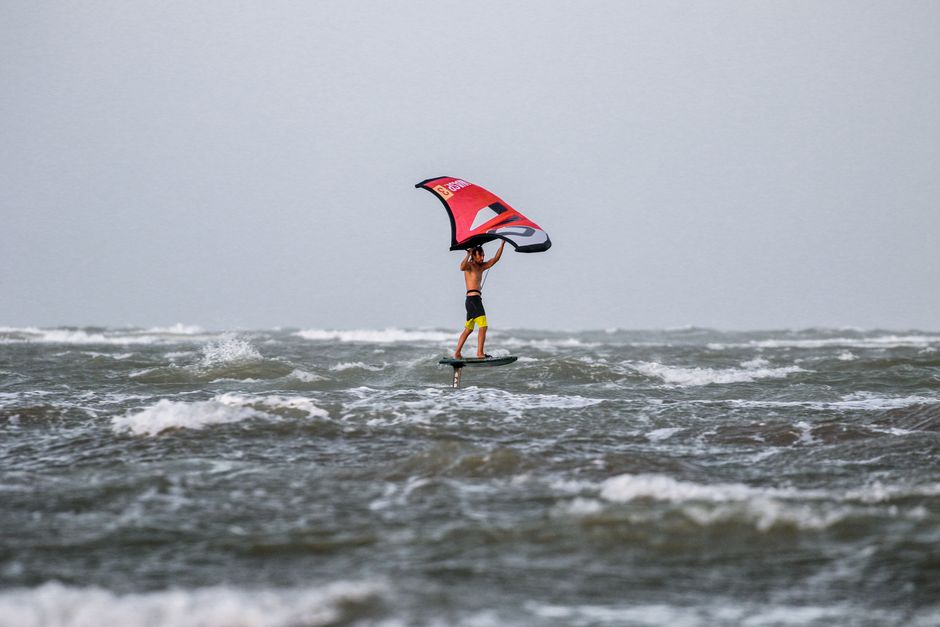
Saturday at a busy bay: twenty wings on the water, a couple of kites further out, paddleboarders along the shore and a group of kids in a lesson near the beach. Nobody has lanes, nobody has a referee, and everyone is moving fast on a sharp foil. What keeps it working is a small set of shared rules. This page covers the wing foiling rules you need on any session (right of way, wave etiquette and foil safety) and the rules of competition, from GWA freestyle heats to wingfoil racing.
For the whole sport, start at our wing foiling hub. Kiters have their own kitesurfing rules of the road, which differ because of the lines.
Right of way: the four rules to know
Wing foilers follow the same basic right-of-way rules as sailors and windsurfers, from World Sailing’s Racing Rules of Sailing (Part 2) and the everyday rules of the road. IKO teaches them in its wing foil course before you ride alone.
- Starboard over port. When two riders on opposite tacks meet, the rider on starboard tack (wind coming over the right side, so the right hand is forward on the wing) has right of way. The port-tack rider keeps clear. The German magazine surf sums it up as “right hand in front is right.”
- Windward keeps clear. On the same tack, the rider further upwind gives way to the rider downwind.
- Overtaking keeps clear. A faster rider coming from behind must pass at a safe distance.
- Everyone avoids a collision. Having right of way never means you can hold your course into someone. Make your move early and obviously.
Wave and swell etiquette
- First on the wave rides it; if two riders catch it together, the one closer to the peak (the breaking part) has priority.
- Riders heading out through the surf have priority over riders coming in on a wave, who must leave them room.
- Surfers and swimmers first. Keep well away from surfers, prone foilers and swimmers, and don’t ride a busy surf lineup with a foil.
Other water users
Under the US Navigation Rules, a sailing vessel or any vessel under 20 meters must not impede a vessel that can only navigate safely within a narrow channel, so stay out of the way of ships, ferries and big boats in channels. Give kiters a wide berth (their lines are long and hard to see), and keep away from swim areas and fishing lines.
Foil safety rules
In the first big study of wingfoiling injuries (415 riders, 2023), the foil or mast caused 26% of injuries, the board 20% and the wing 7%. Not one injury came from contact with another rider. So most foil safety is about your own gear.
- Wear a helmet and an impact vest. In GWA competition, helmets are mandatory and impact vests are recommended, and most recreational riders in the study wore both.
- Protect feet and shins. The study’s authors recommend cut-resistant neoprene boots whatever the water temperature, and suggest shin protection.
- Fall away from the foil. Fall flat and to the side, away from the board, and cover your head with your arms if you come up near it.
- Get to deep enough water before you climb on, and step off into deep water too. The foil hangs well below the board.
- Cover the foil on land. Carry it with care through crowds and on the beach, and use foil covers to protect people, cars and the foil itself.
- Use a wing leash (wrist or waist) and, for the board, a leash made for foils. GWA rules require the wing to be leashed to the rider at all times in racing. Many riders use a coiled leash so it doesn’t drag or tangle.
- Watch out for footstraps. In the study, 24% of ankle injuries came from getting caught in straps during a fall; learn without straps, and add them when you’re ready.
- Stop before you’re tired. Riders blamed 77.5% of injuries on riding errors from fatigue, and most happened in the second hour.
Wind, weather and riding alone
- Know the wind direction. Side-shore and side-onshore winds bring you back to the beach if something goes wrong. Offshore wind blows you away from it; it’s for experts with a rescue boat only.
- Check the forecast and the gusts and choose a wing size you can hold in the strongest gusts, not the average.
- Never ride alone, or at least tell someone on shore where you are and when you’ll be back. Learn self-rescue: in IKO’s course it comes before riding.
- Dress for the water temperature, not the air, as the National Weather Service advises.
Do I need a life jacket?
Rules vary by place, so check with your state, local beach or school. Remember that an impact vest is not a life jacket: the maker of the popular Ride Engine Defender HF vest says plainly it is not a Coast Guard life vest. Many schools put beginners in flotation, and young or weaker swimmers should wear a real life jacket. Our youth page covers kids’ gear.
Rules of competition
The GWA Wingfoil World Tour sanctions four disciplines, all recognized by World Sailing. Every GWA competitor must wear a helmet and a wing safety leash and ride a hydrofoil board.
| Discipline | How it works |
|---|---|
| Surf-Freestyle | Riders battle in heats of two or three, surfing swell and throwing air and surface tricks. Each makes seven trick attempts in turn, and the best three scores, from different trick families, count. Judges score technique, speed, height and execution. |
| FreeFly-Slalom | Up to 12 riders race a multi-leg course with jibes, tacks and sections where they pump or surf the foil without using the wing’s power. Short, seeded races add up to the podium. |
| Wave | Riding real waves for judges. For 2026, the GWA tweaked the rules to let riders use the wing’s power on the same wave face. |
| Big Air | Jumps and aerial tricks for the judges. |
Racing rules and equipment
Wingfoil racing uses World Sailing’s Racing Rules of Sailing; the International Wing Sports Association (IWSA) runs its racing as a World Sailing special event. Equipment rules keep it fair and affordable:
- GWA race class: only production gear made in runs of at least 50; up to five wings, two boards and three foil systems per season; masts no longer than 115 cm and front wings no smaller than 700 square centimeters; wings must be symmetrical with an inflatable leading edge.
- Formula Wing (IWSA): raced on registered series-production equipment; from May 2025, two wings per event instead of three, and every wing must have windows of at least 400 square centimeters per side so riders can see through them. Men’s wing sizes split at 5.5 square meters; women’s and youth (U19) at 5.0.
- X-15: the first one-design wingfoil class recognized by World Sailing, where everyone races identical gear.
Ages matter too: the GWA’s main tour has a minimum age of 14 in the year of competition, with youth divisions at U14, U16 and U19. See our leagues and associations page for the tours and events.
Safety gear that follows the rules
A helmet that meets a water-sports standard, a quick-release wing leash and a foil leash cover the essentials. The Pro-Tec Ace Water helmet (about $66) meets CE EN 1385 for water sports, with 15 vents and sizes from XS (52 to 54 cm) to XL (60 to 62 cm). The Ride Engine quick-release bungee wrist leash (about $65) is made for wing foiling, with a one-handed cuff and a quick release for emergencies. For the board, the Ho Stevie! foil waist leash (about $45) is an 8-foot coiled leash designed for foil boards, and the Slingshot Hover Glide foil cover (about $35) is a padded two-piece cover for the mast and wings, sized for Slingshot’s Hover Glide foils; check that a cover fits your foil.
Prices change often. The prices above are what we saw at the maker or a major retailer in October 2026; check the current price before you buy.
Pro-Tec Ace Water Helmet
- CE EN 1385 water-sports standard
- 15 vents for drainage
- Sizes XS to XL
Ride Engine Quick Release Bungee Wrist Leash
- Made for wing foiling
- One-handed wrist cuff
- Quick release for emergencies
Ho Stevie! Foil Waist Leash (8 ft)
- Coiled, built for foil boards
- Padded waist cuff with key pocket
- Rail saver
Slingshot Hover Glide Foil Cover
- Two-piece: mast and wing/fuselage
- Padded, 600D nylon
- Hook-and-loop and zipper
Keep reading: wing foiling injuries, the full gear guide, wing foiling for kids, and the sailing rules that racing builds on.
Wing foiling rules FAQs
Who has right of way in wing foiling?
The rider on starboard tack (right hand forward on the wing) has right of way over a rider on port tack. On the same tack, the rider upwind keeps clear, and an overtaking rider keeps clear. On waves, the first rider or the one closest to the peak has priority, and riders heading out have priority over riders coming in.
Do you need a helmet to wing foil?
It isn’t the law in most places, but helmets are mandatory in GWA competition and most recreational riders wear one. The foil and board cause the most injuries in wing foiling, and a helmet protects you from a hit by your own gear.
Is an impact vest a life jacket?
No. Impact vests pad your ribs and back in a crash, but they are not approved life jackets. If you need flotation, wear a real life jacket.
Do I need a leash for my wing and board?
Yes for the wing: a wrist or waist leash stops it blowing away when you fall, and GWA racing requires one. Many riders also leash the board with a coiled leash made for foils, so it doesn’t drift off or snag.
What are the GWA wing foil disciplines?
Surf-Freestyle (judged tricks and swell riding in heats of two or three), FreeFly-Slalom (racing a course of up to 12 riders), Wave and Big Air. All four are recognized by World Sailing.