This article contains affiliate links: if you buy through them we may earn a commission, at no extra cost to you. Learn more.
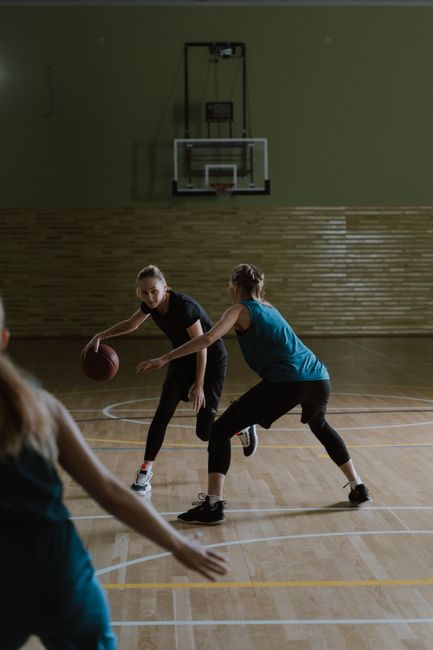
Early on a July morning, the gym is empty except for one kid with a ball, a jump rope and a playlist. Across town a college team runs suicides on the first day of preseason. Somewhere an NBA player is in a quiet weight room working on single-leg landings that nobody will ever see. Good basketball training happens long before the ball goes up. This guide walks through the year: off-season, preseason and in-season. It covers vertical jump and plyometrics, conditioning that matches the game, managing the load, and what changes for young players.
General information, not a personal program. If you’re coming back from an injury or have a health condition, check with a sports medicine doctor, physical therapist or athletic trainer first. Back to the basketball hub.
What a basketball game asks of your body
A systematic review of match-play studies found that players cover about 5–6 km during the live time of a 40-minute game. That distance is made up of short sprints, shuffles, jumps and quick changes of direction, at an average intensity above lactate threshold and above 85% of maximum heart rate. Guards sprint and shuffle more than forwards and centers. Hard efforts drop off in the fourth quarter as players tire, and men and women at the same level face similar demands. So basketball fitness isn’t long-distance running. It’s the ability to repeat explosive efforts, land safely and still have legs in the last five minutes.
The basketball training year
Off-season: rest first, then build
Start the off-season with real time away. The NBA and USA Basketball recommend extended time off organized basketball every year, for physical recovery and to recharge mentally. After that, the off-season is when strength gets built. AAOS advises keeping fitness up year-round with aerobic work, strength training and flexibility, so the body isn’t shocked when practice starts. Off-season priorities for most players:
- Strength: squats, lunges, hinges such as deadlifts or hip thrusts, calf and core work, two or three times a week with good technique.
- Landing mechanics and balance: single-leg balance, soft two-foot landings, knees tracking over the toes. This is the base for safe plyometrics and is linked to fewer ankle and knee injuries (see our basketball injuries guide).
- Skill: the off-season is when shooting and ball-handling improve, so most of the court time belongs to the ball.
Preseason: ramp up, don’t cram
The International Olympic Committee’s consensus on load and injury says poor load management is a major injury risk factor. That includes rapid jumps in training, crowded schedules, travel and mental stress. Preseason is where many players make that mistake, going from summer pickup to two-a-days in one week. Build up court time and conditioning step by step over several weeks. Add game-speed work (repeat sprints, defensive slides, transition runs) and keep the strength work going.
In-season: maintain, warm up, recover
Once games start, the goal is to keep what you built. One or two short strength sessions a week maintain power. A structured warm-up before every practice and game lowers injury risk. In a trial of the FIFA 11+ warm-up in basketball players, injuries fell from 2.16 to 0.95 per 1,000 athlete-exposures. AAOS suggests 3–5 minutes of light cardio such as jumping jacks or a jog before stretching. Sleep and recovery do the rest; see our basketball recovery guide.
Vertical jump and plyometrics
Everybody wants to jump higher, and here the research is clear. A 2022 meta-analysis pooled 32 studies with 818 basketball players. Plyometric jump training improved countermovement jump height, sprint times over short and longer distances, change of direction, balance and maximal strength. Training duration and number of sessions didn’t predict how much players improved, so quality matters more than piling on volume.
There’s an injury bonus too. In a study of high school girls in soccer, volleyball and basketball, girls who did a preseason program of jumping, landing and strength work had far fewer serious knee injuries. Untrained girls had 3.6 times the rate. A meta-analysis found these programs lowered ACL injuries most when started in the mid-teens. A simple progression:
- Learn to land first: drop from a low step, “stick” a quiet landing with knees over toes and hold it.
- Two-foot jumps: squat jumps, tuck jumps, jumps onto a low box, broad jumps. Step down from the box rather than jumping down while you learn.
- Single-leg and lateral work: hops, skater bounds and lateral bounds, the movements basketball actually uses.
- Reactive jumps: rebound-style repeated jumps and depth jumps come last, once landings are solid. A coach or strength professional should supervise them.
- Keep it fresh: do jumps early in a session, rest fully between sets and stop when height or landing quality drops. If you have knee-tendon pain (jumper’s knee), ask your PT how much jumping is right.
Equipment is simple. A soft-sided box like the Yes4All Adjustable Soft Plyo Box (foam, stackable 6- to 24-inch heights) is forgiving on shins. An agility ladder like the SKLZ Quick Ladder covers footwork, and a real game ball such as the Wilson Evolution (official size 29.5 in, NFHS approved, indoor only) keeps the rest of the session about basketball. More ideas in our speed training equipment guide.
Yes4All Adjustable Soft Plyo Box
- EPE foam, PVC cover
- 6, 12, 18 or 24 in, stackable
- Holds up to 440 lb (maker)
Wilson Evolution Game Basketball
- Size 7, 29.5 in
- NFHS approved
- Indoor only
Conditioning that matches the game
Because the game is stop-and-go at high heart rates, conditioning should be too. Mix in:
- Repeat sprints: baseline-to-baseline or half-court sprints with short rests. Build the number of reps over weeks.
- Change of direction: defensive slides, closeouts and backpedal-to-sprint drills. Guards need the most of this.
- Small-sided games: 2-on-2 and 3-on-3 build fitness and skill together, and players actually like them.
- An aerobic base: easy bike, jog or swim sessions in the off-season help you recover between hard efforts. They also give your knees and ankles a break from the court.
Tracking helps. A heart-rate or GPS wearable shows how hard sessions really are, and morning HRV and sleep data give you a read on recovery. See the best wearables for basketball and HRV for athletes.
Load management: why rest is part of training
“Load management” got famous in the NBA, where each team plays an 82-game regular season (October 20, 2026 to April 11, 2027 this season), but the idea applies at every level. The IOC’s expert group counts more than training as load. Games, back-to-backs, travel, school and stress all add up, and sudden spikes are where trouble starts. In practice:
- Raise training and playing time gradually, especially after a break or an injury.
- Count everything: school team, club or AAU, skills trainer and pickup.
- Plan lighter days after games and around tournaments.
- Treat sleep as training. In one Stanford study, basketball players who slept more sprinted faster and shot better (details in our recovery guide).
- Watch for warning signs: lingering soreness, pain that grows with each session, falling performance, bad sleep or losing the fun. These mean back off and, if pain is involved, get checked.
Training young basketball players
The NBA and USA Basketball Youth Guidelines (2016) set out how much organized basketball is enough at each age. Organized means games, practices and coached training, not pickup or shooting on your own:
| Age | Recommended | Maximum | Rest |
|---|---|---|---|
| 7–8 | 1 game and 1 practice (30–60 min) a week | 1 game a day, 3 hours a week | 2 days a week off; max 4 months a year |
| 9–11 | 1–2 games and 2 practices (45–75 min) a week | 2 games a day, 5 hours a week | 2 days a week off; max 5 months a year |
| 12–14 | 2 games and 2–4 practices (60–90 min) a week | 2 games a day, 10 hours a week | 1 day a week off; max 7 months a year |
| Grades 9–12 | 2–3 games and 3–4 practices (90–120 min) a week | 2 games a day, 14 hours a week | 1 day a week off; max 9–10 months a year |
The guidelines also say to delay specializing in basketball until 14 or older. Players near the weekly maximum shouldn’t be playing another sport at the same time. On strength training, the American Academy of Pediatrics says kids can build strength safely with well-supervised programs that focus on correct technique. Balance and posture control usually reach adult levels around age 7 or 8, a sensible earliest start. Programs of 2–3 sessions a week for at least 8 weeks bring strength gains. Bodyweight work, landing practice and fun jumping games are the right start for kids. Heavy lifting and depth jumps can wait for good technique and a qualified coach. See our youth basketball guide for more.
The mental side trains too: routines, visualization and free-throw focus. See our mental training tools. For how another sport handles the same questions, compare our soccer training guide, and for fueling your sessions see basketball nutrition and supplements.
Basketball training FAQs
How can I increase my vertical jump for basketball?
Combine leg strength with plyometrics. A meta-analysis of 32 studies in basketball players found plyometric jump training improves jump height, sprint speed and change of direction. Learn to land well first, train jumps fresh and progress from two-foot to single-leg and reactive jumps.
How many days a week should basketball players lift weights?
Two or three sessions a week is common in the off-season, and one or two shorter sessions in season to maintain strength. For young athletes, the AAP notes strength gains with 2–3 sessions a week over at least 8 weeks, with qualified supervision.
What age can kids start plyometrics and strength training?
The AAP says supervised resistance training with good technique is safe for children. Balance and posture control usually mature around 7–8, a sensible earliest age. Start with bodyweight exercises, landing skills and playful jumping, not heavy loads or high drops.
How many hours a week should a high school basketball player train?
The NBA/USA Basketball guidelines set a maximum of 14 hours of organized basketball a week for high schoolers. They recommend at least one day a week off and some months away from organized basketball each year.
Does conditioning for basketball mean long runs?
Mostly not. Games are short, intense efforts at high heart rates, so repeat sprints, change-of-direction drills and small-sided games fit best. Easy aerobic work still helps in the off-season as a base.
Train with a plan, add load slowly, land like you mean it and rest on purpose. That’s how players get better season after season instead of getting hurt. Next up: basketball game day and basketball gear.