This article contains affiliate links: if you buy through them we may earn a commission, at no extra cost to you. Learn more.
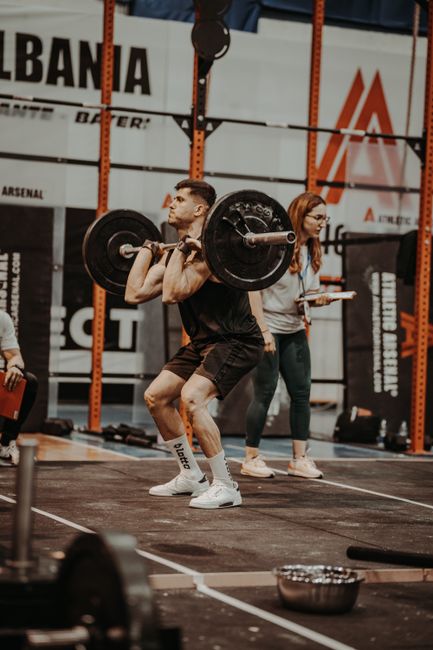
Late February, and the leaderboard is the most-refreshed page in the gym. The whole box has signed up for the Open, the coach is building heats for Friday night, and somewhere in the world a few hundred athletes are doing the same workout to chase a spot at the Games. Behind that night sits a whole structure: a company that owns the name, thousands of independent gyms, coaching credentials, a season of qualifiers, and a growing set of other fitness races and leagues. Here’s who’s who in CrossFit and functional fitness, from your local affiliate to the CrossFit Games, HYROX and beyond.
CrossFit LLC: the company behind the name
CrossFit is not run by a federation. It’s a brand owned by a private company, CrossFit LLC, which licenses gyms to use the name, runs the coach certificate courses and organizes the CrossFit Games season. CrossFit describes itself as “a global fitness brand with a community and a methodology”. Its competition side lives at games.crossfit.com, where the Open, the rulebook and the leaderboards are published.
Affiliates: where CrossFit happens
A CrossFit affiliate (a “box”) is an independently owned gym that pays to use the CrossFit name. CrossFit says there are more than 9,000 affiliates worldwide. Each one sets its own schedule, prices, programming and culture, so two CrossFit gyms in the same town can feel very different. That’s why it pays to visit before you join.
- Ask about the on-ramp. A good gym teaches new members the basics in a beginners’ program or private sessions before regular classes.
- Watch a class. Do the coaches correct form, offer scaling to everyone and keep an eye on the whole room?
- Ask about credentials (below) and class size.
- Ask how they handle injuries. The answer should be “we scale around it and send you to a professional”, not “push through”. In one study, CrossFit athletes had fewer injuries when a trainer was involved. More on our CrossFit injuries page.
Coach credentials: CF-L1 to CF-L4
- CF-L1 (Level 1 Trainer): the starting credential. It’s a two-day course (in person, about 9 a.m. to 5 p.m. both days, or online) on CrossFit’s methodology, the foundational movements, programming, nutrition, seeing and fixing movement faults, and running a class. Since April 1, 2025, the multiple-choice test is taken online after the course. The certificate is valid for five years; the course costs US$1,150 in the US.
- CF-L2: the Level 2 Trainer certificate builds coaching skills; earning it replaces the need to revalidate the L1.
- CF-L3 and CF-L4: the Certified CrossFit Level 3 Trainer and Certified CrossFit Level 4 Coach credentials, for experienced coaches.
- Specialty courses: CrossFit also runs Kids, Spark and Judges courses. The CrossFit Kids course is a two-day course on teaching ages 3 to 17; more on our youth CrossFit page.
A CF-L1 is a starting point, not a medical credential. For pain or injuries, the right people are a sports medicine physician, a physical therapist or an athletic trainer.
The CrossFit Games season: Open to Games
The first CrossFit Games were held in July 2007 on a ranch in Aromas, California, with about 70 athletes. As of the 2026 season, the path looks like this:
- The Open (February 26 to March 16, 2026): three workouts over three weeks, done at an affiliate or on video, in Rx, Scaled or Foundations. About 254,000 athletes registered in 2026.
- Quarterfinals (March 26–30): online, for the top 25% of individuals worldwide plus age-group athletes. Quarterfinals returned in 2026 after a year off.
- Semifinals (April to June): the top 2,000 men and women went to in-person events, such as the Mayhem Classic in Cookeville, Tennessee, the Legends Championship in Del Mar, California, and Copa Sur in Brazil, or to online Semifinals.
- The CrossFit Games (July 22–26, 2026, SAP Center, San Jose, California): 30 men, 30 women and 20 teams. The 2026 champions were James Sprague (men), Aimee Cringle (women) and CrossFit Whip (teams). Age-group finals were held at the San Jose Convention Center.
Teens (14–15 and 16–17), masters (35–39 up to 70+) and adaptive athletes (16 divisions) compete in their own divisions. The rules are on our CrossFit rules page.
HYROX: the fitness race
HYROX is a separate organization with its own race series around the world. Every race is the same: 8 × 1 km runs, each followed by a station (SkiErg, sled push, sled pull, burpee broad jumps, row, farmers carry, sandbag lunges and 100 wall balls). Categories are Open, Pro (heavier on some stations), Doubles and Relay, split by age group. The season ends with the World Championships, held June 18–21, 2026 in Stockholm, Sweden. For kids, HYROX Youngstars races are for ages 8 to 15 in age groups of 8–9, 10–11, 12–13 and 14–15, with a parent or guardian required at the event. Because half the race is running, our running training page is useful prep.
Other functional fitness bodies and leagues
- International Functional Fitness Federation (iF3): a nonprofit founded in 2016 that wants functional fitness recognized as a sport and included in the Olympic Games. It works through national federations (Ukraine, Georgia, Australia, Estonia and Nigeria joined in 2026), runs a World Championships and youth programs, is a WADA signatory and is a SportAccord member.
- World Fitness Project (WFP): a pro league founded by former Games athlete Will Moorad with Isabella and Jackson Terry, which debuted in 2025. In 2026 it held tour stops in London (May 1–3) and Westfield, Indiana (August 28–30), with finals in Copenhagen (December 17–20). Each stop has 50 athletes in the pro men’s and women’s fields and 20 elite teams, plus hundreds of everyday competitors.
- Local throwdowns: most competitive CrossFit happens at one-day local competitions run by affiliates, often with several divisions from beginner to Rx. They’re the best first step after the Open.
There’s no NCAA CrossFit, and functional fitness isn’t an Olympic sport; iF3 and its national federations are the bodies working toward Olympic recognition.
Gear for your first competition
For an Open workout, a local throwdown or a HYROX race, two pieces of kit earn their keep. A shoe that can lift and run: the Nike Metcon 10 (about $155 at Nike) has a stabilizing plate under the heel for squats and cleans and a heel clip for handstand push-ups; Nike says it fits small. And a chest-strap heart rate monitor for pacing: the Polar H10 (about $105 from Polar, often less on Amazon) is an ECG-type chest strap that connects over Bluetooth and ANT+. Our heart rate monitor guide and CrossFit gear guide compare more.
Nike Metcon 10
- Hyperlift plate under the heel
- Heel clip for handstand push-ups
- About $155
Polar H10 Heart Rate Sensor
- ECG-based chest strap
- Bluetooth and ANT+
- Up to 400 h battery
OOFOS OOahh Slide
- OOfoam slide
- APMA Seal of Acceptance
- Machine washable
Back to the CrossFit hub, or see competition day, CrossFit training and our CrossFit recovery routine.
CrossFit organizations questions
Who runs CrossFit?
CrossFit LLC, a private company. It owns the brand, licenses the affiliates, runs the coaching courses and organizes the CrossFit Games season. The gyms themselves are independently owned.
What is a CF-L1 coach?
A coach who has passed CrossFit’s Level 1 Certificate Course: two days of instruction and hands-on coaching plus a test. It’s valid for five years. Higher levels (CF-L2, CF-L3, CF-L4) show more coaching experience and skill.
How do you qualify for the CrossFit Games?
In 2026: finish in the top 25% of the Open to reach Quarterfinals, then among the top 2,000 to reach Semifinals, then earn one of 30 spots per gender (or 20 team spots) at the Games. Age-group, teen and adaptive athletes have their own routes.
Is HYROX part of CrossFit?
No. HYROX is a separate company and race series with its own rules, World Championships and kids’ races. Many CrossFit gyms train members for it, and many athletes do both.
Is CrossFit an Olympic sport?
No. The International Functional Fitness Federation (iF3) is working toward Olympic recognition of functional fitness, but it’s not on the Olympic program.