This article contains affiliate links: if you buy through them we may earn a commission, at no extra cost to you. Learn more.
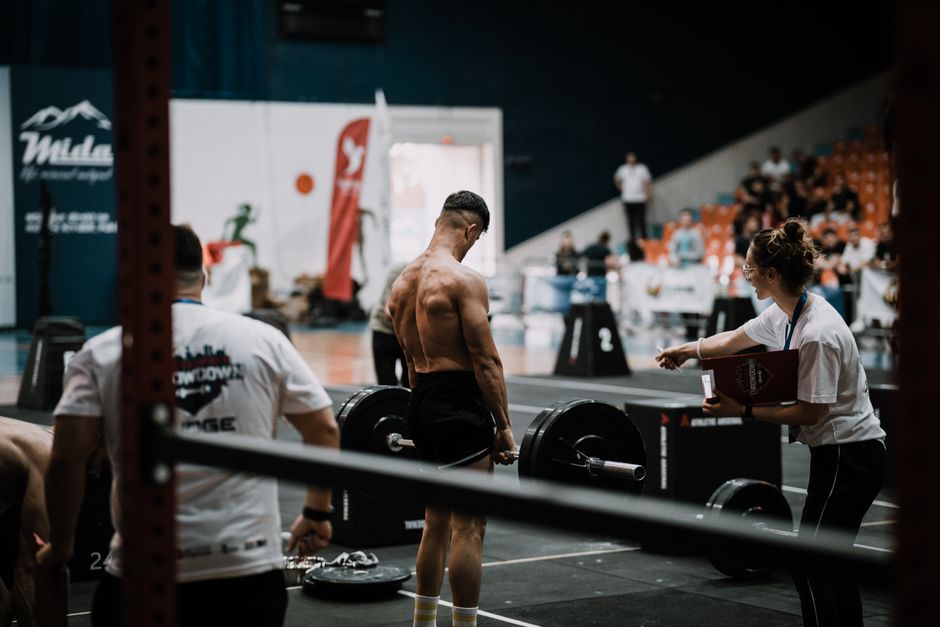
Thursday night of Open week. Your friend from the 6 a.m. class has a clipboard, a stopwatch and a serious face, and you’re at the wall with a 20-pound ball. Twelve minutes later you’ve heard “No rep!” four times, and every one of them was fair: your squat didn’t go below parallel. That’s the moment most people learn that CrossFit rules exist. Daily classes are flexible, but competition has written movement standards, divisions, judges and a scoring system. Here’s how they work, in plain language, from the CrossFit Open to the Games, plus HYROX and the safety rules every box lives by.
Who writes the rules
CrossFit LLC publishes a new CrossFit Games rulebook every season at games.crossfit.com/rules. It covers eligibility, divisions, judging and video submission, equipment, and the medical paperwork required of athletes who make it to the end. Each workout also comes with its own written standards, equipment list and scoring notes. In a regular class, your coach sets the standards and the scaling, but the habits are the same: full range of motion, honest reps.
Who can compete: age and divisions
- Age: for the 2026 season, athletes had to be at least 13 to create a CrossFit Games account and at least 14 by July 14, 2026. Your age on that date set your division for the whole season.
- Individual: men and women, the path to the CrossFit Games.
- Teens: boys and girls 14–15 and 16–17.
- Masters (age groups): men and women 35–39 up through 70+.
- Adaptive: 16 divisions, from upper- and lower-body impairments to intellectual impairments.
- Teams: affiliate teams; Games teams are four athletes, two men and two women.
Rx, Scaled and Foundations
Every Open workout comes in three versions. Rx (“as prescribed”) is the workout as written, the version the athletes chasing a Games spot do. Scaled keeps the same structure with lighter loads and easier gymnastics. Foundations is a step below Scaled, for people new to CrossFit. You can pick a version each week once the workout is released.
A real example: Open workout 26.1 was 12 minutes of wall-ball shots, box jump-overs and medicine-ball box step-overs. Rx men used a 20-lb ball to a 10-foot target and a 24-inch box; Rx women a 14-lb ball to a 9-foot target and a 20-inch box. Scaled men used a 14-lb ball and scaled women a 10-lb ball, with the same target and box heights and step-ups allowed. That’s scaling in a nutshell: the same workout and the same effort, adjusted to the athlete. In daily classes your coach does the same thing every day.
Movement standards: what counts as a rep
Each workout spells out exactly what a rep is. In 26.1, for example:
- Wall-ball shot: squat below parallel, then throw the ball so it hits the target clearly above the required height.
- Box jump-over: jump or step up so both feet touch the top of the box, then step down the other side (no jumping down). The rep counts when both feet are on the ground on the far side.
- Medicine-ball box step-over: carry the ball in any position and step up and over; the ball can’t rest on your thighs or touch the box.
Most standards come down to the same idea: show the full range of motion at the start and the finish of each rep, such as hips below knees at the bottom of a squat, arms locked out overhead, chin over the bar. If you don’t, the judge says “no rep” and you do it again. It isn’t only about fairness. Full-range, controlled reps are also safer than half-reps rushed under fatigue.
Judging and video
- Every score needs a judge or video. The rulebook says judging and validation are required to make a result official. The judge enforces the movement and workout standards and confirms the score, and you enter your judge’s name when you submit.
- At your affiliate: most Open athletes are judged by a coach or gym mate. CrossFit offers an online Judges Course, and for 2026 Quarterfinals judges had to pass the 2026 Judges Course or hold a current Advanced Judges Course certificate.
- On video: athletes training at home, and those in later online stages, film the workout following the rulebook’s video standards. In 2026, public review of videos returned for all divisions, done by judges with a current course certificate. Online Semifinals required videos posted to YouTube.
Scoring: for time, reps and tiebreaks
For time with a time cap: finish all the work and your time is your score. If the cap hits first, your score is the reps you completed. AMRAP: rounds plus reps in the set time. Load: the heaviest successful lift in a window. Tiebreaks: many workouts record a time at set points; in 26.1, the time after your last completed set of box jump-overs or step-overs was your tiebreak, so two capped athletes with the same reps were separated by who got there first.
How the Open ranks you: your place in each workout becomes your points (1 point for first, 2 for second and so on), and the lowest total wins. How the Games rank athletes: since 2011 the winner of each event gets 100 points and lower places get fewer; the most points at the end wins. Between them, the 2026 season sent the top 25% of Open individuals to Quarterfinals, the top 2,000 men and women to Semifinals, and 30 men, 30 women and 20 teams to the Games. Athletes headed to the Games also had to file a medical form completed by a licensed physician.
HYROX rules in brief
HYROX is simpler: the format never changes. Eight times, you run 1 km and then complete one station, always in this order: SkiErg 1,000 m, sled push 50 m, sled pull 50 m, burpee broad jumps 80 m, row 1,000 m, farmers carry 200 m, sandbag lunges 100 m and 100 wall balls. Your score is your total time. Pro uses heavier weights than Open on some stations; Doubles share the station work but run every lap together; a Relay team of four splits the race. HYROX publishes a rulebook each season with the standard for each station, so read it before your first race. More on the organizations on our CrossFit leagues and associations page.
The unwritten rules: safety at the box
- Learn to bail. Know how to drop a barbell safely forward or backward before you go heavy, and give lifters room.
- Clear your space. Keep plates, kettlebells and boxes out of the path of a falling bar, and don’t walk in front of someone mid-lift.
- Collars on, equipment back. Use collars, don’t drop an empty bar, wipe down and put things away.
- Scale honestly. Write “scaled” on the whiteboard when you scale. Nobody minds; ego lifting is how people get hurt.
- Speak up. Tell the coach about injuries, and stop for dizziness, chest pain or dark urine after a workout. See our CrossFit injuries page for warning signs.
Gear that helps you meet the standard
Workouts list the equipment they require: ball weights, target and box heights, barbell loads. Personal gear is up to you. A good speed rope makes double-unders far easier to get right: the WOD Nation Jump Rope is an adjustable steel-cable rope for about $19. For pull-ups and toes-to-bar, many athletes use grips such as the Bear KompleX carbon 3-hole grips (about $49 on Amazon), plus chalk like Cannon Sports gym chalk (eight 2 oz blocks). Ask your gym about its chalk rules. Our CrossFit gear guide and wrist wraps for CrossFit go further.
Bear KompleX Carbon 3-Hole Grips
- Carbon fiber
- 3-hole design
- About $49
Cannon Sports Gym Chalk Blocks
- 1 lb, eight 2 oz blocks
- Magnesium carbonate
- About $18
Back to the CrossFit hub, or see youth CrossFit, CrossFit training and competition day.
CrossFit rules questions
What does Rx mean in CrossFit?
Rx means “as prescribed”: the workout done exactly as written, with the listed weights, heights and movements. Anything changed is scaled. In the Open, you choose Rx, Scaled or Foundations each week, and nobody minds which; the point is to take part.
How old do you have to be to do the CrossFit Open?
For the 2026 season, at least 13 to create an account and 14 by July 14, 2026. Teens compete in 14–15 and 16–17 divisions. Younger kids can do CrossFit Kids classes but not the Open.
Who can judge my Open workout?
At your affiliate, usually a coach or another member; CrossFit offers an online Judges Course, and some stages require a current certificate. At home, you film the workout following the rulebook’s video standards. The judge confirms your score, and you enter their name when you submit.
What happens if I don’t finish under the time cap?
Your score becomes the number of reps you completed, and the tiebreak time recorded during the workout separates athletes with the same rep count.
How is the CrossFit Games scored?
Each event awards points by finishing place, with 100 points for the event winner; the athlete with the most points after the final event is the champion. The Open is different: your placements are added up and the lowest total wins.