This article contains affiliate links: if you buy through them we may earn a commission, at no extra cost to you. Learn more.
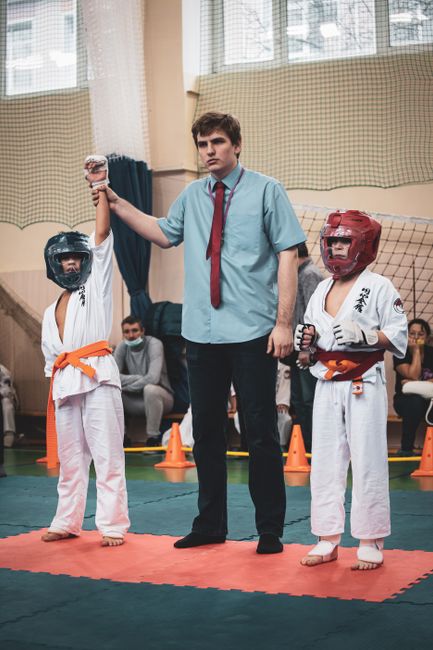
Two karateka bow, the referee calls “Shobu hajime!” and a reverse punch snaps toward the ribs and stops just short. Across the gym a taekwondo scoreboard jumps by three points before anyone saw the kick land, and a jiu-jitsu referee raises four fingers for a mount. Knowing the martial arts rules makes you a safer competitor, a better coach and a calmer parent in the stands. This page covers competition basics for karate, taekwondo, judo and Brazilian jiu-jitsu (BJJ), plus the safety and etiquette rules every school shares.
Rules change, and local tournaments often adapt them, especially for kids. Always read the rules of the event you enter. For the bigger picture, start at our martial arts guide.
Karate rules: kumite and kata
Sport karate under the World Karate Federation (WKF) has two events. Kumite is controlled sparring between two athletes, one in red (aka) and one in blue (ao), refereed by a referee and four judges. Kata is a solo performance of a traditional form.
Kumite scoring
| Score | Points | For |
|---|---|---|
| Yuko | 1 | A punch (tsuki) or strike (uchi) to a scoring area |
| Waza-ari | 2 | A kick to the body (chudan) |
| Ippon | 3 | A kick to the head (jodan), or any scoring technique on an opponent who is down |
The scoring areas are the body from the collarbone down to the belt line (chudan, not counting the shoulders) and the head and neck above the collarbone (jodan). A technique only scores with good form, a sporting attitude, vigorous application, awareness, good timing and correct distance. Contact is controlled: body techniques may land with control, while head techniques must stop close to the target (within 5 cm for kicks and 2 cm for punches for adults) or just touch the skin, and the throat may not be touched at all. For competitors under 14, head techniques score when stopped within 10 cm for kicks and 5 cm for punches; skin touch is allowed only from age 16, and for kicks only between 14 and 16.
Bout length: 3 minutes of actual fighting for seniors and under-21s, 2 minutes for cadets and juniors, and 1.5 minutes for 14 and under. How you win: an 8-point lead ends the bout. Otherwise the higher score at time-up wins; if scores are tied, the athlete who scored the first unopposed point (senshu) wins, and if there’s no senshu the referee and judges vote (hantei).
Fouls and penalties: excessive contact, any contact with the throat, attacks to the limbs, groin, joints or instep, open-hand attacks to the face, dangerous throws (including shoulder and sacrifice throws), faking injury, leaving the area, passivity and clinching are penalized. Warnings go from chui (up to three) to hansoku chui, then hansoku (losing the bout) and, for serious misconduct, shikkaku (removal from the tournament).
Required protection: WKF-approved mitts, a mouthguard, a body protector, shin pads and foot protectors (red or blue to match the athlete), and a groin guard for men. Competitors under 14 must also wear a WKF helmet and chest protector. Fingernails must be short and glasses aren’t allowed.
Kata scoring
Athletes choose from the 102 kata on the WKF’s approved list. A panel of seven judges scores each performance: 70% for technical performance (stances, techniques, transitions, timing, breathing, focus and correct form) and 30% for athletic performance (strength, speed and balance).
Taekwondo rules: electronic scoring
Olympic-style sparring follows World Taekwondo (WT) rules. The version in force from June 1, 2026, changed how turning kicks score, so older guides show different numbers.
How the electronic system works
Athletes wear a Protector and Scoring System (PSS): an electronic trunk protector, electronic headgear and sensing socks. When a kick lands on the trunk protector or head with enough force, the PSS registers the score; the required impact level is set by weight class, gender and age group. Punches can be scored semi-automatically or with sensing gloves, with judges confirming them, and judges add the extra points for turning kicks. Disputed calls can go to instant video replay.
| Technique | Points (WT rules from June 2026) |
|---|---|
| Punch to the trunk protector | 1 |
| Kick to the trunk protector | 2 |
| Kick to the head | 3 |
| Turning kick to the trunk | 4 (doubled) |
| Turning kick to the head | 6 (doubled) |
| Each penalty (gam-jeom) on the opponent | 1 (2 for passivity in the last 10 seconds of a round) |
Rounds: three rounds of 2 minutes with 1 minute of rest. In the standard format a tie goes to a 1-minute golden round; in the best-of-three-rounds format, each round has a winner and you need two. Penalties (gam-jeom) are given for stepping over the boundary line, falling down, avoiding or delaying, grabbing or pushing, lifting the leg to block, attacking below the waist, hitting the head with the hand, kneeing or head-butting, and misconduct. Ten gam-jeom (five in one round in best-of-three) lose the match, and a large point gap ends it early.
Required gear: a WT-approved dobok, trunk and head PSS, groin guard, forearm and shin guards, gloves, sensing socks where the PSS is used, and a white or clear mouthguard at least 3 mm thick. Age groups at WT events: cadets 12–14, juniors 15–17 and seniors 17 and older.
Judo rules: ippon, waza-ari and yuko
Judo’s rules come from the International Judo Federation (IJF). The current cycle brought back the yuko score, which the IJF had dropped in 2017. Contests last 4 minutes of actual time for seniors, juniors (under 21) and cadets (under 18), with at least 10 minutes of rest between contests.
| Score | Throw | Pin (osaekomi) |
|---|---|---|
| Ippon (wins) | Opponent thrown on the back with speed, force and control | 20 seconds |
| Waza-ari | Near-ippon: landing past the side but not fully on the back, or a throw missing one of the ippon elements | 10–19 seconds |
| Yuko | Smaller landings: on the side, on the upper back, or on the side with one elbow down | 5–9 seconds |
A submission also gives ippon, and two waza-ari make ippon (waza-ari-awasete-ippon); yuko never add up to waza-ari. If the scores are equal after regular time, the contest goes to golden score with no time limit: the first score or a disqualification wins it.
Penalties and banned techniques
- Shido: a minor penalty for things like passivity, avoiding grips, leg grabbing or holding the trousers, a hand on the opponent’s face or stepping out. Shido don’t give the other athlete points; the third one is hansoku-make (disqualification).
- Direct hansoku-make for dangerous techniques: diving head-first onto the mat while throwing (for example in uchi-mata or harai-goshi).
- Never allowed: kawazu-gake (leg-entangling throw falling back into the opponent), kani-basami (scissor throw), do-jime (leg scissors on the trunk, neck or head), and joint locks anywhere but the elbow (so no leg locks or wrist locks). Actions that endanger the neck or spine and slamming an opponent back into the mat are also hansoku-make.
- Cadets: athletes under 18 may not use the head to throw or to defend against a throw.
Rules for younger children vary by country and organizer, so check the tournament rules or ask your club.
Brazilian jiu-jitsu rules: IBJJF points and illegal techniques
Most BJJ tournaments follow the International Brazilian Jiu-Jitsu Federation (IBJJF) rule book or something close to it. You win by submission or, if time runs out, on points, then advantages, then fewer penalties, then a referee’s decision. Points count when a position is held for three seconds.
| Position | Points |
|---|---|
| Takedown | 2 |
| Sweep (from guard to top) | 2 |
| Knee on belly | 2 |
| Guard pass | 3 |
| Mount or back mount | 4 |
| Back control | 4 |
An advantage is given for nearly reaching a scoring position or for a close submission attempt. Penalties for stalling or serious fouls escalate: the first is marked, the second gives the opponent an advantage, the third gives them 2 points and the fourth disqualifies. Severe fouls, such as an illegal technique that puts an opponent at risk, disqualify straight away.
Match times (IBJJF): 2 minutes for ages 4–6, 3 for 7–9, 4 for 10–15, 5 for 16–17 and for adult white belts, 6 for adult blue, 7 for purple, 8 for brown and 10 for black. Masters (30 and older) fight 5 or 6 minutes depending on belt.
IBJJF illegal techniques by age and belt
| Group | Not allowed (in addition to the rows below it) |
|---|---|
| Ages 4–12 | Submissions stretching the legs apart (on top of everything banned for 13–15) |
| Ages 13–15 | Chokes with a spinal lock, straight foot locks, Ezekiel (sleeve) choke, front guillotine, omoplata, triangle pulling the head, arm triangle |
| Ages 16–17 (all belts) and adult white belts | Kidney or rib squeeze with the legs, wrist locks, single-leg takedown with the head outside (not penalized) |
| Adult and master blue and purple belts | Bicep and calf slicers, knee bars, toe holds, turning the wrong way in a straight foot lock |
| Brown and black belts, adult and masters (except the adult no-gi division) | Heel hooks, knee-twisting locks, knee reaping, outward pressure in a toe hold |
| Everyone, including adult no-gi brown and black belts | Slams, spinal locks without a choke, scissor takedowns, bending fingers back, suplexes landing on the head or neck, and throwing an opponent on the head from a single-leg defense |
The higher your belt and age, the more you’re allowed. Jumping to closed guard on a standing opponent is also a foul for all white belts and for every belt under 15. In gi divisions, the gi must be white, royal blue or black, with no mismatched jacket and pants; fingernails and toenails must be short and long hair tied up.
Safety and etiquette rules in every school
- Bow in, bow out. Respect at the start and end of class and of each match.
- Tap early, release instantly. In grappling arts, tap with a hand or foot or say “tap,” and let go the moment your partner does.
- Control in striking. Keep head contact light or none, especially for kids; the American Academy of Pediatrics backs rules that keep head blows out of young athletes’ sparring.
- Mouthguard on for sparring, and stop if anyone looks dazed after a knock to the head. See our martial arts injuries page on concussion.
- Clean uniform, short nails, no jewelry, sandals off the mat. It keeps skin infections off shared mats.
Competition-legal gear
Federations publish approved equipment lists. For WKF karate, the Daedo WKF-approved karate gloves are sold on Amazon for about $30. For taekwondo, the adidas ADI-START II is listed as a World Taekwondo-approved dobok (about $43). For BJJ, a gi in white, blue or black such as the Hayabusa Classic Pearl Weave Jiu Jitsu Gi (about $100) fits the IBJJF color rule. Add a mouthguard such as the Shock Doctor Gel Max. More on our martial arts gear page.
Daedo WKF Approved Karate Gloves
- WKF approved (listing)
- Padded sparring mitts
- About $30
adidas ADI-START II Taekwondo Dobok
- World Taekwondo approved (listing)
- V-neck dobok
- About $43
Hayabusa Classic Pearl Weave Jiu Jitsu Gi
- Pearl weave
- For men and women
- About $100
Shock Doctor Gel Max Mouthguard
- Boil-and-bite gel-fit liner
- Breathing channels
- Youth and adult
Related: who runs each art, kids’ rules and belt systems, the MMA rules and the wrestling rules.
Martial arts rules FAQs
How do you score points in karate?
Under WKF rules: 1 point (yuko) for a punch or strike, 2 (waza-ari) for a kick to the body and 3 (ippon) for a kick to the head or a technique on a downed opponent. An 8-point lead ends the bout.
How does taekwondo electronic scoring work?
Sensors in the chest protector, headgear and socks register kicks that land hard enough: 2 points to the body, 3 to the head, doubled for turning kicks under the 2026 rules. Judges confirm punches and turning kicks.
What is the difference between ippon and waza-ari in judo?
Ippon (a perfect throw onto the back, a 20-second pin or a submission) ends the contest. Waza-ari is a near-ippon or a 10–19 second pin; two make ippon. Yuko, the smallest score, is back since 2025.
Are heel hooks legal in BJJ?
In IBJJF events, only for brown and black belts in the adult no-gi divisions. They’re illegal for everyone else, including brown and black belts in the gi and in masters (30 and over) divisions. Other tournaments set their own rules, so read them before you enter.
Can kids do chokes in jiu-jitsu?
Some basic chokes, yes. But under IBJJF rules, children up to 15 can’t use chokes with a spinal lock, Ezekiel chokes, front guillotines or arm triangles (see the table above). Kids should learn to tap early and release right away.