This article contains affiliate links: if you buy through them we may earn a commission, at no extra cost to you. Learn more.
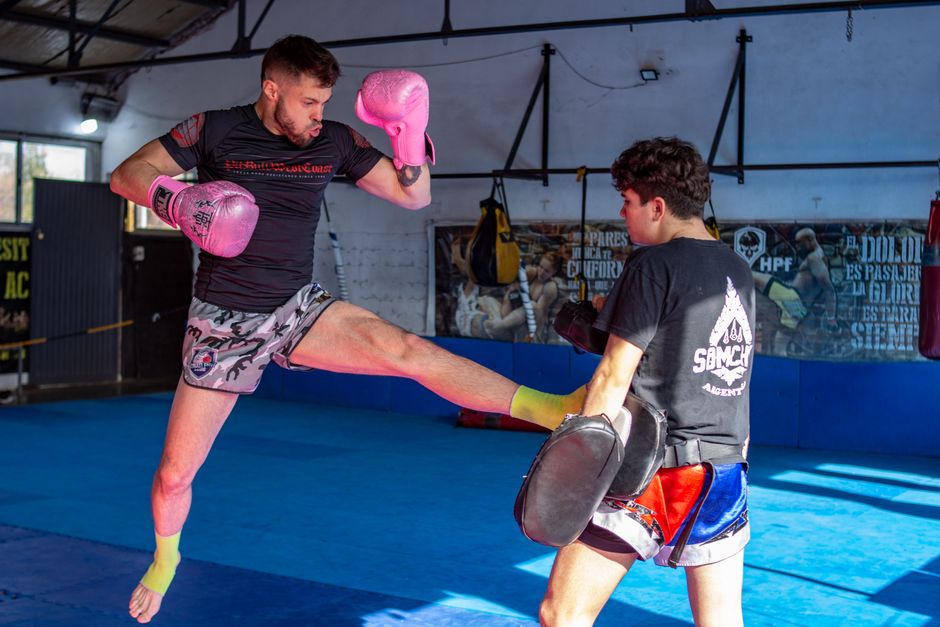
Six o’clock, evening class. Skipping rope to warm up, then shadowboxing in the mirror, then partners pair off: one holds the Thai pads, the other throws jab, cross, roundhouse, and the pads crack like a whip. The trainer calls “again, harder, breathe!” until the bell, then everyone pairs up for ten minutes of clinch, pummeling for the inside grip and landing knees. Then the heavy bags, then sit-ups and a stretch on the mat. That’s a Muay Thai session at almost any level, from a first fitness class to a pro in fight camp. This page explains Muay Thai training: what a fight demands, how to get the most from pads and bags, conditioning, strength for harder kicks, the clinch, what the evidence says about “conditioning your shins”, and how to keep sparring from costing you more than it gives.
General information, not medical or coaching advice. Start any new program gradually, and see a doctor first if you have a health condition. Back to the Muay Thai hub.
What a Muay Thai fight demands
- Round lengths: IFMA amateur Muay Thai uses three 3-minute rounds for elite adults and under-24s, with 2-minute rounds for under-18s and under-16s, 1.5 minutes for under-14s and under-12s, and 1 minute for the youngest divisions. The Association of Boxing Commissions’ unified rules for pro Muay Thai (2024) use 3-minute rounds and three- or five-round bouts, and ONE Championship runs three 3-minute rounds, five for world title fights. Our Muay Thai rules page has the details.
- Both energy systems: a 2017 review of research on kickboxing, Muay Thai’s closest cousin, found fighters need moderate to high aerobic fitness, to recover between exchanges and rounds, plus high anaerobic power and strong, powerful arms and legs for flurries, kicks and clinch battles.
- Legs that last: in a 2026 pilot study at an official Muay Thai championship, 33 amateur fighters jumped and did explosive push-ups before and after their bouts. Power dropped in both arms and legs after a fight, losers lost more than winners, and holding on to leg power after the bout was linked to winning.
Pad work: where skill and fitness meet
Thai pads (forearm-length pads a trainer holds) let you throw full-power kicks, knees, elbows and punches at a moving target. They’re the center of training in Thai camps and most Western gyms. Good pad rounds:
- Teach first, then burn. Early rounds are about clean technique and returning to guard; the last rounds can be fast, high-output “push” rounds, such as non-stop knees or teeps for 30 seconds.
- Include defense. A good holder taps back and throws kicks of their own, so you check, block, catch and counter instead of just hitting.
- Respect the holder. Holding is a skill too. Curved pads with forearm support, such as the Fairtex KPLC5, spread the impact, and holders should meet each kick rather than just absorb it.
Bag work
The heavy bag is where you build power, volume and shin toughness on your own. Muay Thai gyms often hang long “banana” bags so you can kick low and high; at home, a standard 100 lb bag like the Ringside Powerhide works for punches, knees, elbows and body-height kicks. Kicks hit hard: a 2024 review of 88 studies found roundhouse kicks reaching foot speeds up to about 18 m/s and impact forces large enough to cause fractures, so wrap your hands, wear proper bag gloves like the Fairtex BGV1 or Title Classic Pro Style, and build kicking volume gradually. Many coaches use bag rounds two ways: technical rounds (combinations, angles, kicking off a punch) and conditioning rounds (non-stop output for a set time, like 30 seconds hard, 30 easy).
Conditioning
- Aerobic base: the morning run is a tradition in Thai camps, but cycling, rowing or long easy rounds of shadowboxing and skipping build the same engine with less pounding on legs that already take kicks.
- Sport-specific intervals: in a 2026 trial with 20 elite Muay Thai fighters, a short program of Muay Thai-style high-intensity intervals (weighted-glove shadowboxing and explosive sandbag kicking) improved anaerobic power more than their usual training, while aerobic fitness kept pace.
- Rope: a speed rope like the WOD Nation trains footwork, calves and rhythm, and it’s the classic warm-up.
- Measure it: a chest strap such as the Polar H10 shows how hard your rounds really are and how quickly your heart rate drops in the rest minute. More on our Muay Thai wearables page.
Strength and kick power
A review of combat-sport research found that strength and power, not bigger aerobic numbers, separated higher-level combat athletes, with strikers relying on fast, light-load power. Muay Thai now has its own evidence: in a 2026 controlled trial with 39 highly trained Muay Thai athletes aged 15 to 25, six weeks of tire squats plus explosive kicking drills, added to normal training, made their roundhouse kicks land faster after a signal, hold up better over repeated kicks, and stay more consistent than in fighters who kept their usual routine. Balance and left-right differences didn’t change.
In practice that means two or three short strength sessions a week off-season (one or two in camp) built on squats or split squats, hinges such as deadlifts or hip thrusts, presses, rows and pull-ups, plus jumps, med-ball throws and rotational core work, then fast kicking drills on the bag or pads.
The clinch
The Muay Thai clinch is a sport inside the sport: you fight for the inside grip on the neck, off-balance your partner and land knees, and judges reward it. It demands grip, a strong upper back, hips that can turn a partner, and a neck that holds posture under pull. Partner clinch rounds are the main tool, backed by rows, pull-ups, farmer’s carries and sled pushes. Neck training is common, but a 2026 review found the evidence that a stronger neck lowers concussion risk is inconclusive; train it for posture and comfort in the clinch, not as concussion protection. Keep clinch sparring inside the rules: IFMA lists hip throws, hooking the legs, lifting and joint locks as fouls.
Shin conditioning: myths vs evidence
Every Muay Thai gym has stories about fighters kicking banana trees or rolling bottles up and down their shins. Here’s what we could and couldn’t find:
- Bone does adapt to load, slowly. Stress-fracture research describes injury when repeated loading outruns the bone’s ability to adapt, with training errors and low energy intake as key risks. Long-time karate and kobudo practitioners in one study had denser heel bones than less experienced ones. That supports gradual, repeated loading over months and years.
- We found no studies showing that hitting your shins with sticks, rolling bottles or kicking trees makes them tougher or prevents injury. A lot of “conditioning” comes from technique (kicking with the lower shin, checking properly) and from getting used to the feeling of contact.
- Repeated trauma has costs. Bruises and lumps on the shin are common, a review of leg kicks links shin kicking with stress on the shinbone, and a 2026 case report described a kickboxer who needed emergency surgery for compartment syndrome after repeated calf kicks in sparring.
The sensible approach: kick the bag and pads regularly, add volume a little at a time, wear shin guards such as the Fairtex SP5 for partner drills and sparring, eat enough to fuel training, and back off when a bruise or sore spot keeps you from kicking normally. Pain in one spot of the shinbone that lasts for weeks deserves a doctor, as our Muay Thai injuries page explains.
Sparring load: train the skill, limit the hits
Sparring is where you learn to fight, and also where most head contact outside fights happens. In a 2026 case study, a world-class Muay Thai fighter’s sensor mouthguard recorded 590 head impacts in seven sparring sessions before a fight. In boxers and MMA fighters, more sparring has been linked to signs of brain stress and slower thinking. IFMA bars a knocked-out athlete from competing and sparring for at least 30 days, and applies the same rules to head injuries in training.
- Mostly light: technical sparring, body-and-legs only rounds, clinch-only rounds and flowing “play” sparring most weeks.
- Hard sparring rarely, only in a fight camp, with a coach watching and partners matched for size and level. No full elbows to the head in the gym.
- Full gear: mouthguard, headgear, shin guards and elbow pads.
- Symptoms mean stop: headache, dizziness or fog means no sparring until a doctor clears you.
A sample week (example only)
| Day | Recreational / amateur | In a fight camp |
|---|---|---|
| Mon | Class: pads, bag, technique | Pads + bag; strength |
| Tue | Easy run or bike | Technical sparring; clinch rounds; easy run |
| Wed | Class + strength | Pads; intervals |
| Thu | Rest or mobility | Easy aerobic; mobility |
| Fri | Class: light or technical sparring, clinch | Planned hard sparring (short); strength |
| Sat | Bag rounds or a long easy session | Pads; long easy run |
| Sun | Rest | Rest |
Kids and teens should train with age-appropriate coaching; the American Academy of Pediatrics supports supervised strength training for young athletes with good technique and gradual progression, and our youth Muay Thai page covers contact rules by age. In the last week before a fight, most coaches cut volume but keep some sharpness. See our fight day and recovery pages, and compare with kickboxing training and MMA training.
Training gear we’d start with
Fairtex BGV1 Boxing Gloves
- Premium leather
- Handmade in Thailand
- 8–16 oz options
Title Classic Pro Style Training Gloves 3.0
- 8–16 oz options
- Multi-layer foam
- About $35
Fairtex KPLC5 Lightweight Thai Pads
- Curved, lightweight foam
- Forearm support
- For the pad holder
Ringside 100 lb Powerhide Heavy Bag
- 42 x 14 in, soft-filled
- Chain and swivel included
- About $220
Polar H10 Heart Rate Sensor
- Chest strap ECG sensor
- Bluetooth + ANT+
- Up to 400 h battery
For shin guards, elbow pads and the rest, see our Muay Thai gear page; for more strength tools, our resistance bands guide.
Muay Thai training: FAQs
How often should I spar in Muay Thai?
There’s no official number. Most coaches keep the bulk of sparring light and technical, plus clinch rounds, and save hard rounds for fight camps, a short session at a time. Never spar with concussion symptoms.
Does kicking trees or rolling bottles condition your shins?
We found no research showing it works. Bone adapts gradually to repeated loading, so regular bag and pad kicking with slowly rising volume is the evidence-friendly route, and repeated hard trauma can cause injuries.
How long are Muay Thai rounds?
Three minutes for adults in IFMA amateur bouts (three rounds) and in pro bouts (usually three or five rounds). Youth rounds are shorter, from 2 minutes for under-18s down to 1 minute for the youngest children.
Will lifting weights make my kicks better?
It can help. In a 2026 trial, six weeks of tire squats plus explosive kicking drills made trained Muay Thai athletes’ roundhouse kicks faster to land and more repeatable. Two or three short strength sessions a week fit around skill work.
Do I need to run for Muay Thai?
Running is traditional in Thai camps and builds an aerobic base cheaply, but it isn’t the only way. Cycling, rowing, rope and long easy rounds build the same engine with less pounding on legs that already take kicks.