This article contains affiliate links: if you buy through them we may earn a commission, at no extra cost to you. Learn more.
Watch a good skater warm up and it looks like nothing: a few lazy pushes, a couple of ollies, a carve around the bowl. Then they drop in and land a trick that takes a lifetime to learn. Skateboarding has no coach blowing a whistle for most people, but the body still needs training. Balance, leg power, ankles that can take a bad landing, and hips that let you get low. Whether you’re 9 and just learning to push, a teen filming a part, an adult picking the board back up at 40, or chasing a spot at a World Skate contest, this page covers how to train for skateboarding off the board and how to progress on it without breaking yourself.
General information, not a personal program. If you have pain or a past injury, check with a sports medicine doctor, physical therapist or certified athletic trainer first. Back to the skateboarding hub.
What skating actually asks of your body
Science on skateboarding performance is still young. A 2024 scoping review in Sports Medicine found only 19 studies on the physical and technical demands of the sport, and none that linked them directly to contest results. What it did find: some evidence that flexibility and fast, explosive force from the legs matter, for example for ollie height. A 2024 study of 45 skaters tested at skateparks found that static and dynamic balance, lower-body strength and endurance were the fitness traits that best separated higher-level skaters from the rest.
That fits what every skater feels: you need to balance on a moving board, absorb landings, pop hard, and do it again and again in a long session. So the off-board plan has four parts: balance, leg strength and power, mobility, and a body that can take falls.
Balance training
Skating itself is the best balance training, but a few minutes off the board help, especially after an ankle sprain. The National Athletic Trainers’ Association recommends a balance and neuromuscular program of at least 3 months for athletes who have sprained an ankle, because a previous sprain is the biggest risk factor for the next one.
- Single-leg stands: 30 seconds each side, then with eyes closed, then on a cushion.
- Single-leg reaches: balance on one leg and reach the other foot forward, sideways and back.
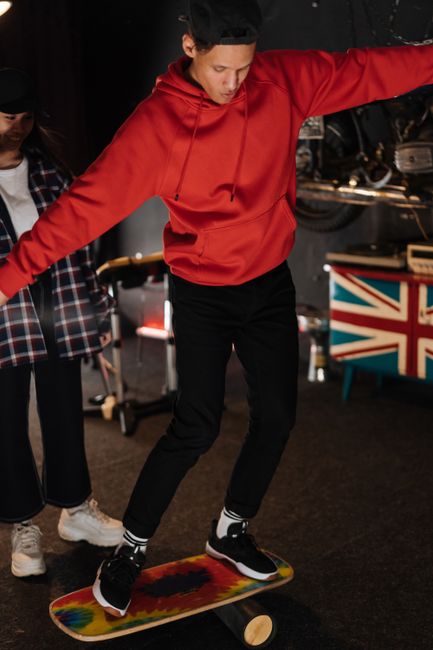
- Balance board: a roller board like the Indo Board (first made for surf training) mimics the shifting deck. Start next to a wall or a friend and on carpet. It’s an extra, not a substitute for skating.
- Hops and landings: hop on one foot and stick the landing quietly, knee over toes.
Leg strength and power
Strong legs pop higher and land softer. Two or three short sessions a week are plenty for most skaters:
- Squats (bodyweight, then goblet squats) and split squats or lunges for each leg.
- Calf raises, two legs then one, slow on the way down: calves and ankles take every landing.
- Hip work: glute bridges and side-lying or banded side steps. A set of loop bands like Fit Simplify fits in a skate bag.
- Jumps: squat jumps and box jumps with soft landings build the quick force the research points to. Keep the reps low and the quality high.
- Core and upper body: planks, side planks and push-ups help you stay stable in the air and catch yourself on the ground.
Young skaters can lift too. The American Academy of Pediatrics (AAP) says supervised, technique-focused resistance training is safe and useful for kids and teens, and gains come with 2 to 3 sessions a week over at least 8 weeks. Bodyweight work and light loads, taught well, are the place to start. Our best resistance bands guide has more options.
Mobility: hips, ankles, upper back
Skating rewards a low, relaxed stance and ankles that bend. Five minutes before a session goes a long way: leg swings, deep squat holds, ankle rocks (knee over toes against a wall), hip openers like the “world’s greatest stretch”, and thoracic rotations for the twisting in 180s and carves. Many skaters roll their calves, quads and hips with a foam roller like the TriggerPoint GRID before or after; see our best foam rollers guide.
The Original Indo Board
- Deck plus roller
- Developed for surf training
- About $199
Fit Simplify Loop Bands
- Set of 5, extra light to extra heavy
- 12 x 2 in natural latex
- About $16
TriggerPoint GRID 1.0
- 13 in, hollow core
- Multi-density surface
- About $40
A warm-up before you skate
Cold legs and stiff ankles make for sloppy landings. Before the big stuff:
- 3–5 minutes of easy pushing and carving to warm up.
- Leg swings, ankle rolls, a few squats and lunges.
- A few easy tricks you can land every time, then build up.
- Check your board: tight trucks, no cracks, wheels spin clean. AAOS suggests inspecting equipment before every use.
Progressions: learn in the right order
The American Academy of Orthopaedic Surgeons (AAOS) is clear about the order: learn to stop, slow down and turn first, then tricks; and practice tricks and jumps in a controlled place, like a supervised skatepark, not in the street. It also warns not to go faster than your experience allows. A path that works for most new skaters:
- Stance, pushing, stopping (foot brake, then tail drag) on smooth flat ground.
- Turning and carving, kick turns, then riding small transitions.
- Falling on purpose: practice crouching, rolling and, with pads, knee slides. See skateboarding injuries for AAOS’s falling tips.
- Ollie on flat, then ollies while rolling, then up a curb.
- Drop-ins, rock to fakies and small ramps with a helmet and pads.
- Flip tricks, grinds and bigger features, one step up at a time.
A simple rule many skaters use: try a new trick when you’re fresh, not at the end of a three-hour session when your legs are gone.
Kids, teens, adults and contest skaters
- Kids: AAOS doesn’t recommend skateboarding under age 5, and ages 6–10 need an adult watching. Keep it playful: balance games, short sessions, full pads. More on our youth skateboarding page.
- Teens: growth spurts change balance and coordination; that’s normal. Add basic strength work and rest days.
- Adults coming back: your skills come back faster than your tissues adapt. Shorter sessions, more warm-up, and strength work for ankles and hips.
- Contest and Olympic hopefuls: the sport is getting younger and deeper. A study of 23 years of international street contests found the number of competitors since 2016 has roughly doubled for men and quadrupled for women, with estimated peak performance around 16–18 for women and 21–22 for men. Structured strength and conditioning is now part of the elite picture.
The mental side: fear is information
Every skater has stood at the top of a drop-in with their heart pounding. Some fear keeps you safe; it means the step is big. Break it into smaller pieces (roll in on a smaller ramp, practice the motion on grass), skate with friends who are encouraging, and don’t let anyone pressure you into a trick you’re not ready for. After a bad slam, it’s normal for confidence to take time to come back. If a hard fall left you with headache, dizziness or fogginess, that’s not fear; that’s a reason to stop and get checked.
After the session, see skateboarding recovery; for contest days, see session and contest day. Athletes in field sports can compare with soccer training.
Skateboarding training: FAQs
What exercises are good for skateboarding?
Balance work (single-leg stands, balance boards), leg strength (squats, split squats, calf raises), jumps with soft landings, hip and core work, and mobility for ankles and hips. Research on skaters points to balance, lower-body strength and endurance as the traits that matter most.
Do balance boards help with skateboarding?
Many skaters and surfers use them for extra balance practice, and balance training is recommended after ankle sprains. There’s no research showing a balance board makes you better at tricks, so treat it as a supplement to skating, not a replacement.
How can I ollie higher?
Technique first (a strong pop and a full slide of the front foot), then strength and power: squats, calf raises and jump training. A scoping review found some evidence that fast force from the legs and flexibility relate to ollie height, though the research is limited.
Should kids lift weights for skateboarding?
The AAP says supervised, technique-focused resistance training is safe for children and teens. Start with bodyweight and light loads, 2–3 times a week, with an adult who knows good form.
What should a beginner learn first?
AAOS says to master stopping, slowing down and turning before tricks, and to learn how to fall. Then the ollie, small ramps and drop-ins, always with a helmet and pads.