This article contains affiliate links: if you buy through them we may earn a commission, at no extra cost to you. Learn more.
Halfway through the bike leg of his first Olympic-distance race, a man on a borrowed road bike tucks in behind a faster rider to catch his breath. A motorcycle pulls alongside, an official holds up a blue card and calls his number: “Drafting penalty. Stop at the next penalty box.” He loses a minute standing in a tent. Most triathletes learn the triathlon rules like that, one penalty at a time. This page saves you the trouble. It covers the USA Triathlon rules (2026 edition) for the swim, wetsuits, transitions, the bike (drafting, helmets, equipment) and the run, the penalties, and where IRONMAN’s own rules differ.
USA Triathlon’s Multisport Competition Rules apply to every USAT-sanctioned race, from a local sprint to the national championships, and also cover duathlon, aquathlon and aquabike. Elite and draft-legal races add extra rules. Always read the athlete guide too: race directors set details like swim cut-offs and course maps.
The quick list
- Wear the official swim cap; wetsuits only when the water temperature allows.
- Helmet on and buckled from the moment you take the bike off the rack until it’s back on the rack.
- No riding in transition: mount after the mount line, dismount before the dismount line.
- Stay 12 meters behind the rider ahead; finish any pass within 25 seconds; ride on the right, pass on the left.
- No headphones or earbuds, in any segment. Phones and watches only for navigation, tracking or data.
- Race number visible on the run; never swap or sell a bib.
- No outside help except from race staff, no pacers, no littering, no nudity in transition.
Swim rules
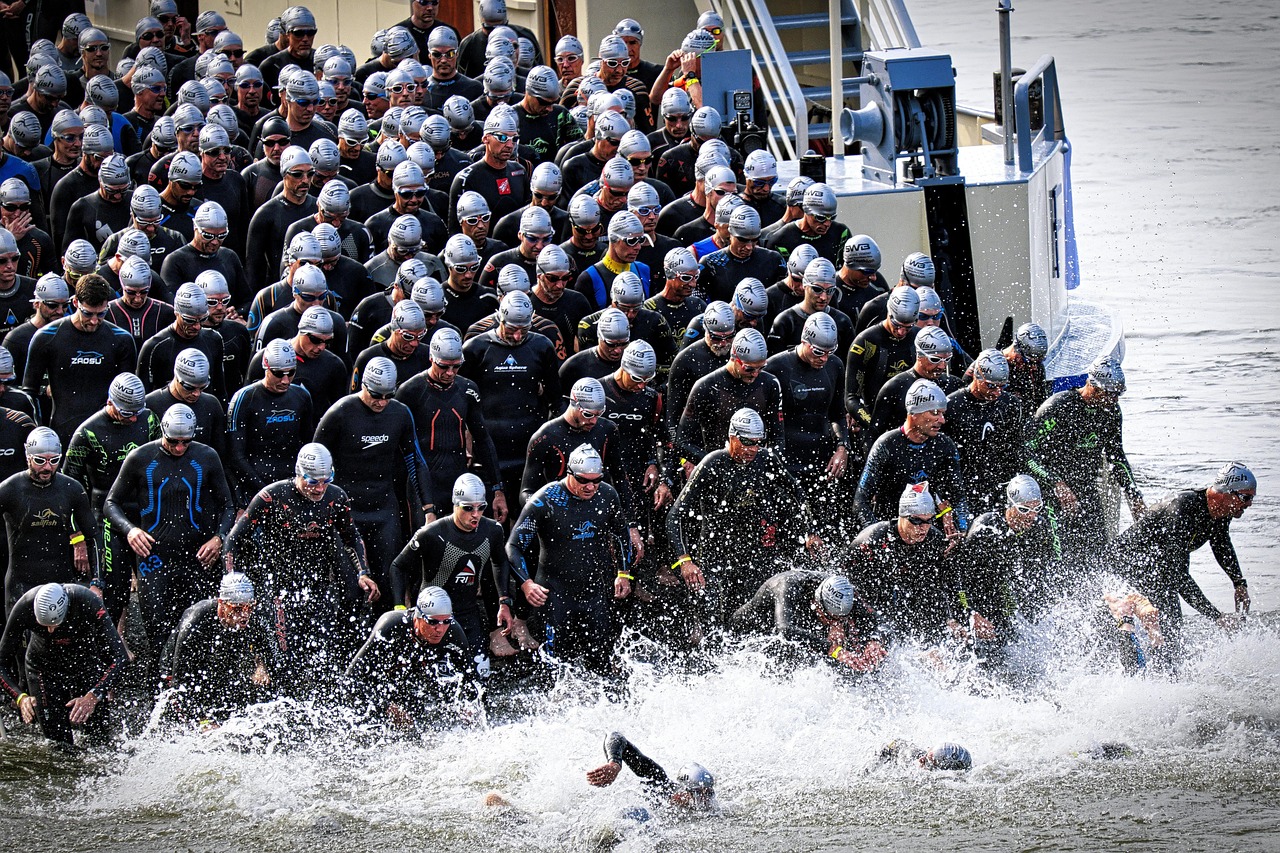
Any stroke is allowed, and you may tread water, float, stand on the bottom or rest by holding a buoy or a stationary boat, as long as you don’t pull yourself forward. In trouble, raise an arm overhead and call for help; if you accept help beyond something to hold on to, you must withdraw. Contact happens in a crowded swim: accidental bumps aren’t penalized, but impeding someone on purpose earns a time penalty and deliberately targeting another swimmer means disqualification. Wear the official cap (a second cap goes under it), and don’t drop your cap on the way to transition. Fins, paddles, snorkels and flotation devices are banned; regular ear plugs are fine.
Wetsuit temperature rules
Wetsuit rules depend on the water temperature, measured about an hour before the start. For most USA Triathlon age-group races and waves:
| Water temperature | Wetsuit |
|---|---|
| 60.6°F (15.9°C) and below | Mandatory |
| 60.7–78.0°F (16.0–25.5°C) | Permitted |
| 78.1–83.9°F (25.6–28.8°C) | Allowed, but you’re not eligible for age-group awards or rankings |
| 84.0°F (28.9°C) and above | Prohibited |
Stricter cut-offs apply at USAT national championships and World Triathlon qualifying races (wetsuits banned at 76.2°F and above) and in elite races (68.0°F for 1,500 m swims or shorter). IRONMAN allows age-group wetsuits up to 76.1°F and may offer a separate non-competitive wetsuit wave up to 83.8°F. A wetsuit may be no thicker than 5 mm anywhere and may not cover the face, hands or feet. Neoprene boots and socks are allowed when wetsuits are; gloves only when wetsuits are mandatory. In cold water the referee can shorten the swim or cancel it: for example, the swim is cancelled if the adjusted water temperature is below 53.6°F or the air is below 42.8°F.
When wetsuits are banned, your swimwear must be 100% textile (no neoprene or polyurethane), must not cover your neck and must not go past your elbows or knees. That’s where a swimskin comes in, a thin textile suit worn over your tri suit, such as the Synergy SynSkin 3 (about $100). Neoprene “buoyancy shorts” are not allowed.
Transition rules
- Your spot: one bike per athlete, racked in your assigned space before transition closes, with your gear next to it. You may lay down a towel or mat, but no markers to find your spot.
- The helmet: while you swim, your helmet waits in transition with the strap unbuckled. Buckle it before you take the bike off the rack, and unbuckle only after the bike is back on the rack. You may not run with your helmet on.
- Mount and dismount lines: push the bike by hand inside transition. One foot must touch the ground past the mount line before you ride, and before the dismount line when you come back. Riding through transition is a disqualification.
- Others’ gear: don’t move it; if you knock it over by accident, put it back. Don’t stop in the flow lanes.
- Nudity: forbidden. Change under your tri suit, or in a changing tent at long races.
Speed in transition comes from simple tricks: elastic laces such as Lock Laces (about $10, and the maker says they were first designed for triathletes) and a race belt so you clip your number on instead of pinning it.
Check the Lock Laces price on Amazon
Bike rules: drafting, passing and blocking
Almost all age-group races are draft-illegal. The draft zone is 12 meters (39.3 feet, about six bike lengths) long, measured back from the front wheel of the rider ahead, and covers the whole width of the road. You may enter it only to pass, and you have 25 seconds to get your front wheel past theirs. Age-groupers may approach straight from behind; elites must move to the side first. Once you’ve been passed, you must drop back out of the passer’s zone right away; re-passing before you drop back is a violation too. Behind motorcycles the zone is 15 meters, and 35 meters behind other vehicles.
Ride single file on the right, pass on the left, and don’t sit in the middle of the lane blocking riders behind you. Obey traffic laws and never cross the yellow line unless a traffic official tells you to. The draft zone doesn’t apply near aid stations, entering or leaving transition, at sharp turns, or for safety. In draft-legal races (elite, junior, NCAA and some age-group events) you can ride in packs, but age-groupers need traditional drop handlebars, no aerobars, and can’t draft off the other gender or lapped riders.
Helmet and bike equipment rules
- Helmets: compulsory, approved by a recognized testing authority (in the US, look for the CPSC label), and not altered. Riding without one in the race means disqualification. Your helmet number sticker must stay visible.
- Bikes: one bike, safe and in good repair (glued tires, tight headset and bars, true wheels), with a freewheel. Recumbents and fairings are banned, and so are mirrors unless you have a medical exemption.
- Bottles: up to 2 liters mounted on the front of the bike, and no more than two bottles of up to 1 liter each mounted behind the saddle. No bottles or “aero” inserts stuffed in the front of your suit or in sleeves.
- Devices: no headphones, bone-conduction headsets or smart helmets. GPS watches and bike computers are fine; calls, texts, music and photos are not.
- Riding position: in draft-illegal races your support points are feet on pedals, hands or forearms on the bars and seat on the saddle.
Any CPSC-certified bike helmet that fits is race-legal. The Giro Register MIPS is a no-fuss option with a universal adult size (54–61 cm) and a dial fit, for about $40 to $85. Our triathlon gear page covers aero helmets and bikes, and cycling rules and road safety covers training rides on open roads.
Check the Giro Register MIPS price on Amazon
Run rules
Run or walk (crawling is not allowed), and you may even go barefoot. Your run number must be visible and unaltered, which is why most triathletes wear a race belt. No pacers or friends running alongside, no headphones, and no grabbing posts or trees to swing around corners. Shoes follow World Athletics road rules: a stack height over 40 mm or more than one rigid plate is banned. At USAT national events, no family in the finish chute and zip up your suit before you cross the line.
The Nathan Race Number Belt (about $20 list, often less) has toggles that hold the number, reflective details and fits waists of 26–44 inches. Clip it on in T2 and you’re ready to run.
Check the Nathan Race Number Belt price on Amazon
Penalties: yellow, blue and red cards
Officials can give a warning for small, unintended problems, with a chance to fix them. A yellow card is a time penalty for things like blocking or passing on the wrong side; a blue card is for drafting or not dropping back after being passed. Bike-course penalties are served at the next penalty box, where you stop, can’t fix your bike or use the restroom, and wait until released. A red card is a disqualification. How long you wait depends on the bike course:
| Bike course | Blue card (drafting) | Yellow card |
|---|---|---|
| Under 20 km (super sprint) | 30 seconds | 5 seconds |
| 20 km (sprint) | 30 seconds | 10 seconds |
| Over 20 km, under 80 km (Olympic) | 1 minute | 15 seconds |
| 80–90 km (middle distance) | 2 minutes | 30 seconds |
| Over 90 km (long distance) | 3 minutes | 1 minute |
Two or more blue cards on a bike course shorter than 80 km, or three or more on longer courses, may lead to disqualification. Selling or transferring your race number means disqualification and a one-year USAT suspension. IRONMAN races use their own rulebook: the age-group draft zone is also 12 meters with 25 seconds to pass (20 meters for pros), a yellow card costs 30 seconds at 70.3 and 60 seconds at full distance, a blue card 2 or 3 minutes, and three blue cards mean disqualification. Blue cards also cover intentional littering there.
Youth, duathlon and aquathlon rules
Youth events (ages 6–15) have simpler rules: helmet buckled before mounting, shoes on the bike, ride at least two bike lengths behind the rider ahead, no aerobars or disc wheels, and penalties of 1 minute, then 2 more, then disqualification. Parents can’t help during the race. See our youth triathlon page. Duathlon uses the bike and run rules; in an aquathlon that starts with a run, you may carry your cap and goggles on the first run.
Nathan Race Number Belt
- Toggle number holders
- Reflective details
- Fits 26-44 in waist
Lock Laces Elastic No-Tie Laces
- 48 in, stretch to 72 in
- One size, kids and adults
- About $10
Giro Register MIPS Helmet
- MIPS rotational liner
- Universal adult fit (54-61 cm)
- About $40 to $85
Synergy SynSkin 3 Swimskin (Men's)
- Thin hydrophobic fabric
- YKK zipper, bonded seams
- About $100
Back to the triathlon hub, or see triathlon race day for setting up transition, who runs triathlon, and swimming rules for pool racing.
Triathlon rules questions
What is the draft zone in triathlon?
Under the 2026 USA Triathlon rules it’s 12 meters (about six bike lengths) behind the front wheel of the rider ahead. You can enter it only to pass, and you have 25 seconds to complete the pass. IRONMAN uses the same 12 meters and 25 seconds for age-groupers.
What is the wetsuit cut-off temperature?
In most USAT age-group races wetsuits are fine up to 78°F; between 78.1 and 83.9°F you can wear one but lose award eligibility; at 84°F and up they’re banned. National championships and IRONMAN use lower limits (76.2°F and 76.1°F for awards).
Can I wear headphones in a triathlon?
No. USA Triathlon bans headphones and headsets of any kind, including bone-conduction models, in every segment. You can carry a phone or wear a watch for navigation, tracking or data, but not for music or calls.
Can I use aerobars in a triathlon?
Yes, in draft-illegal races, which covers most age-group triathlons. They’re not allowed in age-group draft-legal races, which require drop handlebars, or in youth races.
What happens if I get a drafting penalty?
An official shows a blue card and calls your number. You must stop at the next penalty box for 30 seconds to 3 minutes depending on the bike distance, then carry on. Skipping the box means disqualification, and repeated blue cards can get you disqualified too.