This article contains affiliate links: if you buy through them we may earn a commission, at no extra cost to you. Learn more.
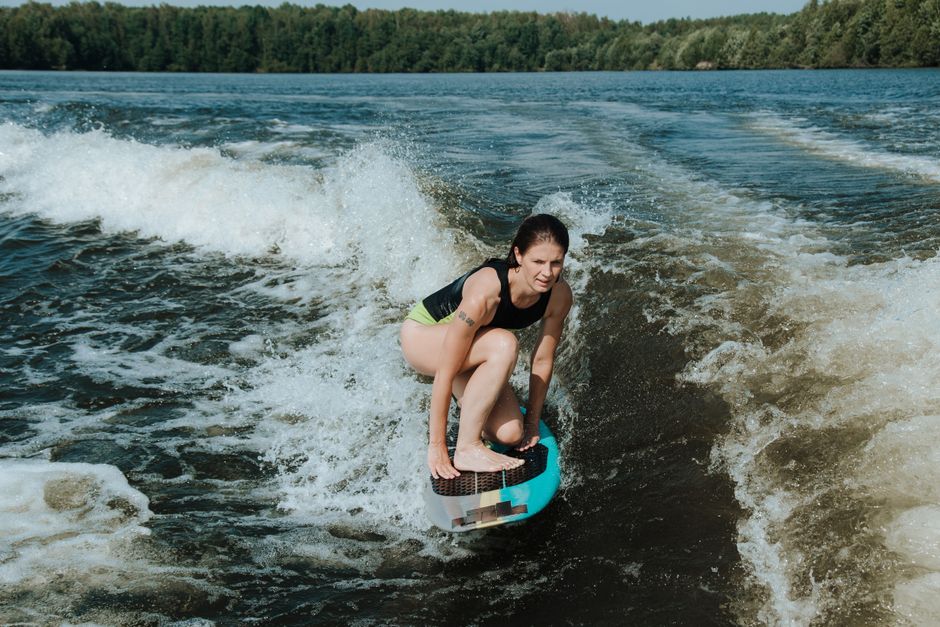
The first time you drop the rope and actually stay on the wave, it feels like magic: no handle, no pull, just you, a small board and an endless wave a few yards behind the boat. Then you try to move forward in the pocket, your back foot wobbles, and you sink off the back of the wave. Wakesurfing looks easy because the speeds are slow. What it really asks for is balance, strong legs in a low stance, a core that steers the board, and the fitness to swim back to your board again and again. This page is about wakesurf training: the land work that helps you stay in the pocket longer, learn tricks faster and get hurt less, for kids, weekend riders and competitors in surf and skim style.

General information, not a personal program. If you’re coming back from an injury, have pain, or have a health condition, work with a physical therapist (PT), certified athletic trainer (AT) or strength coach. Back to the wakesurfing hub.
What wakesurfing asks of your body
- Balance without bindings. Your feet are free on the board, so every adjustment comes from your ankles, knees and hips. The International Waterski & Wakeboard Federation (IWWF) describes it as riding freely on the boat’s wake, “much like surfing on the ocean”.
- A low, loaded stance. You speed up and slow down by shifting weight between your feet and pumping the board, which works the quads, glutes and calves for the whole ride.
- Rotation and control. Contest judges look for airs, turns, carves and technical tricks, ridden frontside and backside, regular and switch, according to the World Wake Association’s judging criteria. Surf style uses bigger, finned boards and powerful carves; skim style uses thin, flat boards for spins.
- A short pull at the start. You get up with a short rope, then let it go. The start is brief, but it’s the moment a 2023 case report linked to a torn biceps when the rope tangled around a beginner’s arm.
- Lots of swimming. Every fall means swimming back to your board, in a life jacket, often many times a set.
We found no research on training for wakesurfing, so the plan below borrows from what works in board sports and in sports with landings and rotation: balance, leg strength, core control and fitness, built up gradually. The injuries themselves, and the boat and exhaust risks that no training can fix, are on our injuries and safety page.
Balance first
Balance is the skill that decides how long you stay in the pocket. Balance training also protects ankles: the National Athletic Trainers’ Association (NATA) recommends at least three months of balance training after an ankle sprain. Build it in steps:
- Single-leg stands on the floor, then with eyes closed, then on a cushion. Thirty seconds a side to start.
- A balance board in your surf stance. The Indo Board was originally developed for surf training, and its roller mimics a board moving under your feet. Stand next to a wall or a friend at first, because falls on land hurt more than falls in the lake.
- Practice both stances. Riding switch (the other foot forward) and surfing both sides of the wake earn points in contests and make you a better rider at the lake.
- Add movement: small squats, slow turns of the shoulders and soft “pumps” on the board, the way you’d move on the wave.
Legs for the low stance and landings
Strong legs let you stay low, pump for speed and absorb landings from airs and spins. In team sports, programs that combine strength, landing practice and balance work cut ACL injuries by about half in a large review of the research; riders can use the same ingredients two or three times a week:
- Squats and split squats (bodyweight first, then load), including slow pauses at the bottom to build the low surf stance.
- Romanian deadlifts and hip bridges for the hamstrings and glutes that help protect the knee.
- Calf raises and single-leg work for the ankles that steer a board without bindings.
- Landing drills: small hops onto soft ground, landing quietly with knees bent and pointing over the toes, never caving in. Add height and spin only when landings are clean.
Core and rotation
Your trunk turns the board. Carves, cutbacks and 360s start with the shoulders and hips, and a tired core lets the board slide out from under you. Train it to resist movement and to rotate under control:
- Planks and side planks, building to 30 to 60 seconds with good form.
- Pallof presses with a resistance band: stand side-on and press the band straight out without letting it twist you.
- Controlled rotation: band or cable chops and lifts, and medicine-ball rotational throws, for carves and spins.
- Bird dogs and dead bugs for control, and rows and band pull-aparts for posture and the start.
The start, the rope and your arms
Wakesurfers don’t need the forearm endurance of a wakeboarder or slalom skier, because the rope is gone after a few seconds. The start still matters: let the boat pull you up slowly with your heels on the board and knees bent, rather than hauling yourself up with your arms. Rows and pull-ups keep your upper back strong, and light band work for the rotator cuff keeps shoulders healthy. Most important, never wrap slack rope around a hand or arm, a rule the boating industry’s Discover Boating safety tips spell out and the biceps case report shows the reason for. Use a short, thick wakesurf rope, and let go when a fall starts.
Swimming fitness
Even in contests, wakesurfers swim back to their board after a fall: the World Wake Association’s World Series rules say a rider “may only swim to his/her board”. At the lake, a set with ten falls is ten swims in a life jacket. Swimming laps, or easy cycling, rowing or running two or three times a week, means you arrive at your board with breath to spare. Being a confident swimmer is also basic water safety for everyone on the boat.
The Original Indo Board
- Board and roller included
- Originally developed for surf training
- Start next to a wall
TriggerPoint GRID 1.0 Foam Roller
- Firm, textured foam
- Compact for the boat bag
- About $40
SWELL Pro Wakesurf Rope
- 24 ft, 3 sections
- 3/4 in thick floating line
- About $80
Warm up on the dock or the boat
Most riders go from sitting in the boat straight to a deep-water start. Five minutes changes that: leg swings, walking lunges or squats, hip circles, a few soft hops, arm circles and some trunk rotations. First set of the day: easy riding, finding the pocket and a few gentle turns before any airs or spins. A few minutes on a foam roller the night before or after the session suits people who like it.
The off-season
- Two or three strength days a week covering legs, hinge, core and rotation, pulling and shoulders.
- Balance work two or three times a week, in both stances.
- Other board sports. Many wakesurfers ocean surf, skateboard or snowboard in winter to keep their board feel. Each has its own risks and protection; see our surf training, skateboarding and snowboarding sections.
- Fix old injuries with a PT while the lake is cold, not in July.
- Ramp back up in spring. Short sets for the first rides, and save the big airs for when your legs remember the wave.
A sample week
A practical example, not a prescription. In season: ride 2 to 4 days, one short strength session (legs, core, rotation) on a non-riding day, balance work at home two or three times, and at least one full rest day. Off-season: 2 to 3 strength sessions, 2 conditioning sessions (swimming is ideal), balance work 2 to 3 times a week, and rest. For kids and teens, the American Academy of Pediatrics recommends at least one to two days off a week from organized sport, and time away from a single sport during the year. More on young riders on our youth page.
For bands, see our best resistance bands guide. Fuel for training is on the nutrition page, boards and ropes on the gear page, and a watch with a Wakesurf mode on best wearables. Riding with bindings and a long rope? That’s wakeboard training. For a team-sport take on prevention training, compare soccer training.
Wakesurf training: FAQs
What muscles does wakesurfing use?
Mostly legs and core: quads, glutes and calves to hold a low stance and pump the board, the small muscles of the ankles and hips for balance, and the trunk to turn the board and spin. The arms work briefly at the start and for swimming back after falls.
Is a balance board good training for wakesurfing?
Yes, as an extra. A roller board like the Indo Board, first designed for surf training, works stance, ankles and reactions. Start next to a wall, practice both stances, and keep doing strength work too.
How do I stop falling off the back of the wave?
It’s mostly technique: shift weight onto your front foot and pump the board to move forward in the pocket, and back onto your rear foot to slow down. Off the water, balance work and a strong low squat make those weight shifts easier to control.
Does wakesurfing help with ocean surfing?
Many surfers use it to practice turns and stance on an endless wave, but the two differ: in the ocean you paddle, duck-dive and pop up from lying down, which wakesurfing doesn’t train. If you surf both, add paddling fitness from our surf training page.
How should I train in the wakesurfing off-season?
Get strong two or three times a week (legs, core, rotation, pulling), keep your fitness with swimming or cycling, do regular balance work, rehab any lingering injury, and ease back onto the wave in spring before you try big tricks.