This article contains affiliate links: if you buy through them we may earn a commission, at no extra cost to you. Learn more.
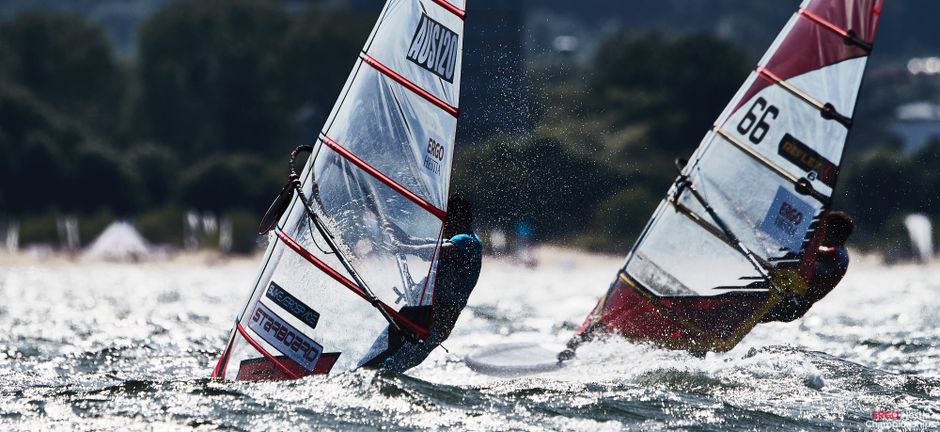
A breezy Saturday at a busy windsurf beach. A dozen sails are crisscrossing the bay, two sailors are heading straight for each other at speed, a beginner is uphauling near the shore and a foiler is flying past a meter above the water. Nobody collides, because everyone knows the same few rules. On a normal day there’s no referee, so the windsurfing rules that matter most are the right-of-way rules and the safety habits that keep a crowded spot fun. Then there are the racing rules, all the way up to the Olympics. This page covers both in plain words.
For the big picture, start at our windsurfing guide.
Right of way: the windsurfing rules of the road
Windsurfing borrows its right-of-way rules from sailing. “Tack” means which side the wind comes from, and the racing rules define it for boards by your hands: you’re on starboard tack when your right hand is the one nearer the mast, and on port tack when it’s your left.
- Starboard tack has right of way. The sailor on port tack keeps clear.
- On the same tack, the windward board keeps clear of the leeward (downwind) board.
- Overtaking? Keep clear. A board coming up from behind keeps clear of the one ahead.
- Turning gives up your rights for a moment. Under the windsurfing racing rules, once you pass head to wind in a tack, you keep clear of other boards until your sail has filled again.
- Give room to anyone who has fallen. The racing rules say a board should, if possible, avoid a board that has capsized or hasn’t regained control yet. At the beach, that also means beginners, who can’t steer around you.
- Jumps and tricks come with no right of way. Look downwind before you jump and never jump close to other sailors or swimmers.
The rule above all rules: having right of way doesn’t let you hit anyone. The other sailor may not know the rules or may not have seen you behind their sail, so change course early and obviously. On a foil, give extra room, since a foil wing under the water is hard to see and sharp.
Kites, boats and shipping lanes
Windsurfers often share water with kitesurfers, whose long lines are hard to see; stay well clear of kites, especially downwind of them. Think beyond the beach, too. Under the US Coast Guard Navigation Rules, small sailing craft must not impede vessels that can only navigate in a narrow channel, and a ferry or a ship can’t stop or turn for you. Stay out of channels and harbor mouths and keep well clear of swimmers, surfers and anchored boats. Kitesurfers have their own right-of-way habits; see our kitesurfing rules page.
Safety rules every windsurfer should know
Windsurfing has one big safety advantage: if you let go, the sail drops and the power is gone. Most safety rules build on that. Windsurf schools such as Germany’s VDWS teach a short list:
- Stay with your board. It floats, it holds you up and it’s far easier to see than a swimmer. Leave your equipment only if you absolutely must.
- Stay calm and save your energy. If you can’t sail back, roll up the rig on the board and paddle in, or wait for help.
- Signal for help. The standard distress signal is to slowly and repeatedly raise and lower your outstretched arms. A whistle on your vest helps people hear you.
- Check before you go. Look at the forecast, the wind direction and your gear (uphaul, harness lines, mast foot, fin or foil screws). Avoid offshore wind, which blows you away from land.
- Don’t sail alone in doubtful conditions, and tell someone where you’re going and when you’ll be back.
- Match your gear to the wind. Sail size, board volume and fin should fit the wind, your weight and your skill. Being overpowered with too much sail is a classic cause of crashes.
Foiling adds its own rules: fall away from the board and foil, never toward them, wear a helmet and impact vest, and keep the foil covered on the beach. In a study of iQFOiL racers at the 2021 European Championships, a third of injuries came from hitting equipment, and the foil was the most damaging single piece. The iQFOiL Youth and Junior class rules require a helmet, a whistle and an impact vest that meets a flotation standard at all times.
Three small pieces of kit cover most of those rules: a loud whistle such as the Fox 40 Classic (about $7) clipped to your vest, a helmet such as the Pro-Tec Ace Water (about $66), which meets the CE EN 1385 water-sports helmet standard, and an impact vest such as the Ride Engine Defender HF (about $164) for foiling and jumping.
Pro-Tec Ace Water Helmet
- CE EN 1385 water-sports standard
- 15 vents for drainage
- Sizes XS to XL
Ride Engine Defender HF Impact Vest
- Made for foiling incl. windsurf
- Impact shells in high-risk areas
- Not a life jacket
Beach rules and life jackets
Many beaches have local rules for windsurfing: rigging areas, launch zones and access lanes, seasonal bans when beaches are crowded, or areas closed for wildlife. Rig where the locals rig, use the access lanes, keep your gear off paths and stay well away from swimming areas. Never leave a rigged sail loose on the beach; lay it down with the mast upwind so a gust can’t pick it up. Read the signs, talk to the local school or club, and follow what they ask; one careless sailor can get a spot closed for everyone.
Life jackets: federal US rules exempt sailboards from the requirement to carry a life jacket, and state rules vary, so check where you sail. Flotation is still smart for beginners, kids, cold water and anyone sailing far from shore, and many races and youth programs require it. Remember that most impact vests protect against hits but aren’t certified flotation; check the label.
Racing rules: how windsurf races work
Windsurf races run under World Sailing’s Racing Rules of Sailing, with a special section, Appendix B, for windsurfing fleet racing. A few of its changes show how different board racing is from boat racing:
- Pumping is allowed. Boats are limited in how they can move their sails, but windsurfers may pump and fan the sail. They may not paddle, swim or walk the board forward.
- Touching a mark is OK, but holding on to it isn’t.
- Sail up before the start. In the last minute before your start, your sail must be out of the water, unless you’ve fallen by accident.
- Three ways to start: upwind starts and reaching starts with flags, and beach starts from numbered stations when the start line is on or near the beach.
- Marathon races are races meant to last more than an hour. A sailor who breaks a rule can usually take a 360-degree turn penalty on the spot.
iQFOiL: Olympic windsurfing
The iQFOiL is a one-design foiling windsurfer: everyone races the same equipment. US Sailing lists a 2.2-meter board and sails of 7.3 square meters for women and 8.0 for men. Events mix three formats: course racing (upwind and downwind, about 20 minutes at Paris 2024), short downwind slalom sprints and a long-distance marathon race. The top 10 then go through knockout rounds to a final race where the finishing order decides the medals. At LA28 the windsurfing finals are scheduled for July 20, 2028, at Belmont Shore in Long Beach.
Slalom, wave and freestyle
On the PWA World Windsurfing Tour, slalom is a straight race: heats of sailors blast around a short downwind course on fins or foils, and the best advance. Wave and freestyle are judged: sailors compete in heats, and judges score jumps, wave rides or tricks. Our leagues and associations page explains the tours, classes and championships.
Keep exploring: windsurfing for kids, windsurfing injuries, gear, and our sailing rules page for the full racing rules.
Windsurfing rules questions
Who has right of way in windsurfing?
The sailor on starboard tack, with the right hand nearer the mast. On the same tack, the windward (upwind) board keeps clear, and a board overtaking from behind keeps clear. Whatever the rules say, everyone must try to avoid a collision.
What should I do if I can’t sail back?
Stay with your board, stay calm and save your energy. If you can, roll the sail up on the board and paddle in. If you need help, slowly raise and lower your outstretched arms and blow your whistle.
Is pumping allowed in windsurf racing?
Yes. Appendix B of the Racing Rules of Sailing lets windsurfers pump and fan the sail, unlike most boats. Paddling, swimming or walking the board forward are not allowed.
Do windsurfers need a life jacket?
Federal US rules exempt sailboards from carrying one, but state and local rules can differ, and many races and youth programs require flotation. It’s wise for beginners, kids and cold or open water.
How does Olympic windsurfing work?
Sailors race identical iQFOiL foiling windsurfers in course races, slalom sprints and a marathon. The top 10 then race knockout rounds to a final, where the finishing order decides the medals. At LA28 the final is scheduled for July 20, 2028.