This article contains affiliate links: if you buy through them we may earn a commission, at no extra cost to you. Learn more.
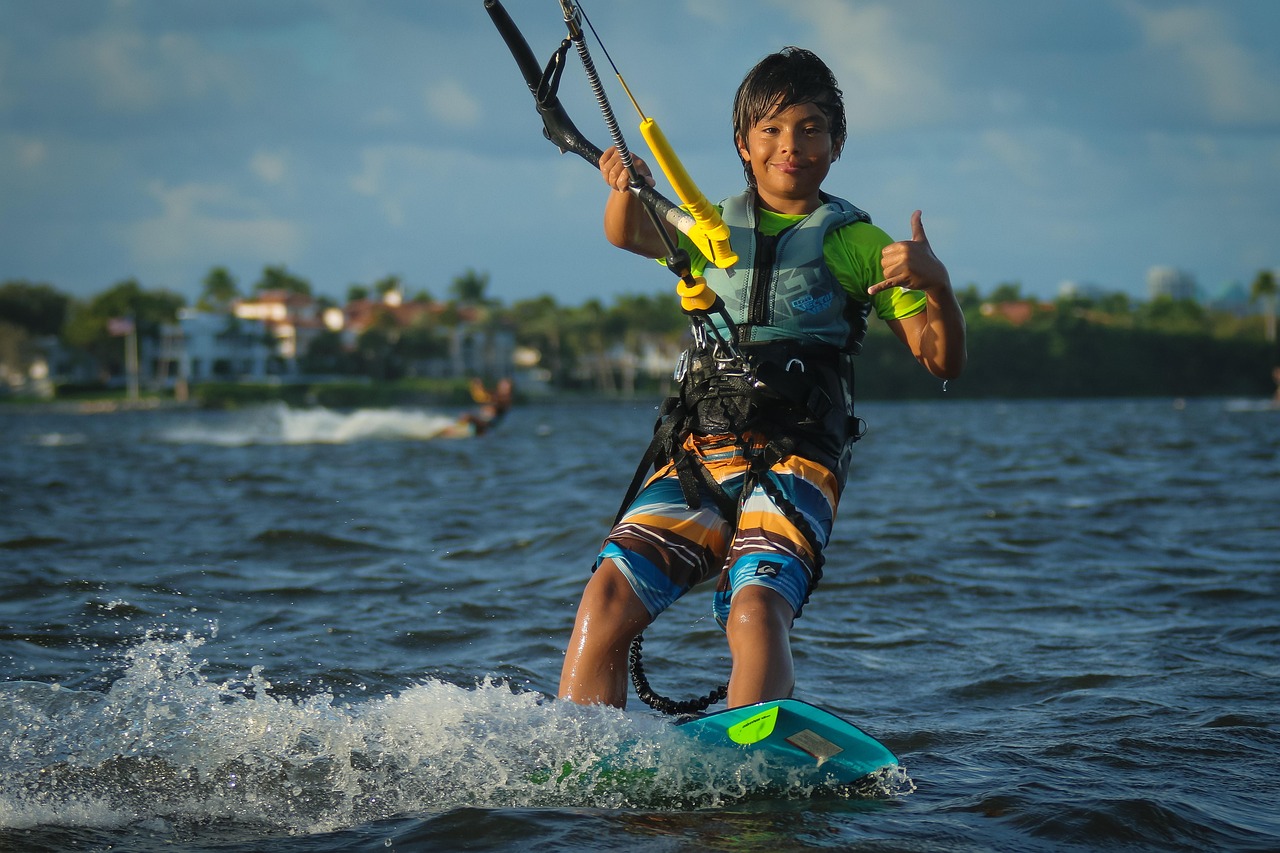
A 12-year-old on a breezy beach with an instructor at her shoulder, steering a small trainer kite in figure eights while her parents watch from a towel. Two summers later she’s riding upwind on her own, and the next year she’s at her first youth regatta. Plenty of families go down this road, and the most common questions are the same: how old is old enough, is it safe, and how do we find good lessons? This page answers them for kitesurfing for kids and teens, from the first trainer kite to youth racing.
For the whole sport, see our kitesurfing hub. If your child is starting on a windsurf board instead, see windsurfing for kids.
What age can kids start kitesurfing?
The International Kiteboarding Organization (IKO) sets a minimum age of 12 for its first course, Discovery, along with a minimum swimming level. Younger children can be taught, but IKO requires the instructor to complete its online course on teaching children first. In practice, size and strength matter as much as age: a kite pulls in proportion to the wind and its size, so light kids need small kites, lighter wind and a school with kid-sized gear. Ask the school how they decide.
- Trainer kites: kids can learn how a kite flies on the beach long before they ride. Small two-line kites like the HQ Symphony Beach III 1.3 (about $48), which the maker rates for ages 8 and up, are a fun start.
- Kitefoiling: best left until a teen rides a twin-tip confidently, upwind and in both directions; the foil adds speed and a hard, sharp wing under the board. In a 2026 survey of 3,138 kitesurfers, cuts were 31% of major injuries among riders in the race discipline, which is raced on foils.
- Jumping: big jumps are where rib injuries and concussions pile up in the research. Let jumping come late, with an instructor, a helmet and an impact vest.
- Competition: the GKA Kite World Tour’s minimum age is 14 in the year of competition; its Youth World Tour runs U14, U16 and U19 brackets.
Lessons with certified instructors
For kiting, lessons aren’t optional. IKO itself calls kiteboarding “an extreme sport that can be dangerous” and steers beginners to certified instructors. In the US, schools are usually certified by IKO or by PASA (the Professional Air Sports Association), which certifies kiteboarders at three skill levels and instructors through a five-day program. IKO’s pathway goes from Discovery (about two hours on average) to Intermediate (relaunching the kite, self-rescue, the water start) to Independent (about eight hours on average, including riding upwind and self-launching). IKO says most lesson packages run 6 to 9 hours and cost $350 to $900.
What to ask a kite school
- Is the instructor IKO or PASA certified, and current in first aid and CPR?
- Have they taught kids your child’s age and size, and do they have small kites and boards?
- Where do they teach? Shallow, flat water with side-onshore wind and a clear beach is ideal; ask what they do when the wind is too strong or gusty.
- Do they use radio helmets or a support boat, and how many students per instructor?
- Is safety gear included: helmet, impact vest or flotation, wetsuit?
- How do they decide a child is ready to ride without supervision?
The first lesson is mostly on the beach: setting up the kite, the safety systems and quick-release, flying the kite and landing it. That’s by design. In a 2004 study of 235 kitesurfers, 56% of injuries were blamed on riders who couldn’t detach from the kite after losing control, and in a Norwegian study 82% of accidents were put down to operator error or lack of experience. Learning the release and good judgment from day one is the best protection there is. Our rules of the road and safety page explains the quick-release.
Safety gear for young riders
- Helmet: a water-sports helmet such as the Pro-Tec Ace Water (about $66, CE EN 1385, XS to XL). A Norwegian study of kite injuries recommended a helmet and a life vest for kitesurfing.
- Flotation: a US Coast Guard-approved youth life vest like the O’Neill Youth Superlite (about $41, Type III, for 50 to 90 lb) for younger and lighter kids, or whatever the school specifies to fit with a harness. Impact vests protect against hits but are not life jackets.
- Wetsuit and sun protection: dress for the water temperature, not the air, as the National Weather Service advises; kids lose heat fast in the wind. In warm water, a UPF 50+ rash guard like the O’Neill Youth Basic Skins long sleeve (about $24 to $30) plus a broad-spectrum, water-resistant SPF 30+ sunscreen reapplied every two hours, as the American Academy of Dermatology recommends.
- Feet: neoprene booties for shells, rocks and reef.
Concussion: recognize and remove
Falls from jumps, hits from the board and hard landings can cause concussions; in the Norwegian study, half of the head, face and neck injuries were concussions. The CDC’s HEADS UP program asks parents to watch for a child who seems dazed or confused, is slow to respond, or complains of headache, dizziness, nausea, light sensitivity or trouble concentrating. Take them off the water for the rest of the day, keep them out until a healthcare provider clears them, and call 911 for danger signs such as seizures, passing out, a worsening headache or repeated vomiting.
From lessons to youth racing
Many kids ride for fun and never race. For those who want to, the ladder is clear:
- Local clubs and regattas come first, with friendly races and downwinders.
- Formula Kite, the Olympic class, raced on hydrofoil boards, for teens who want to race.
- The U.S. Youth Championship: the 2026 edition, October 9 to 12 at Alamitos Bay Yacht Club in Long Beach, includes Formula Kite; racers must not turn 20 that year.
- The US Sailing Youth Team: athletes under 19 earn spots through qualifying events, with up to four places in Formula Kite (two women, two men).
- Freestyle: the GKA Youth World Tour for U14, U16 and U19 riders.
US Formula Kite star Daniela Moroz began her international Formula Kite career at 14 and went on to win multiple world titles and finish fourth at the Paris 2024 Olympics. Our leagues and associations page lays out every step. Young racers on the water for hours also need real food, fluids and sleep; see our session day page and recovery page.
Before lessons, or for a windy weekend at the beach, the Slingshot Trainer Kite (about $139) comes with a bar, lines, a safety wrist leash and a bag; Slingshot suggests the 2-meter size for children and the 3-meter B3 for adults.
Slingshot Trainer Kite (2 m)
- Ram-air trainer with bar and lines
- Safety wrist leash and bag
- 2 m size suited to children (maker)
HQ Symphony Beach III 1.3 Stunt Kite
- 51 in dual-line foil kite
- Flies in 6 to 31 mph wind
- Ready to fly
Pro-Tec Ace Water Helmet
- CE EN 1385 water-sports standard
- 15 vents for drainage
- Sizes XS to XL
O'Neill Youth Superlite USCG Life Vest
- USCG Type III
- 50 to 90 lb
- Three quick-release buckles
More for young athletes: the full gear guide, kitesurfing injuries, youth sailing and youth surfing.
Parents’ questions about kitesurfing
What is the minimum age for kitesurfing lessons?
IKO’s Discovery course has a minimum age of 12 and requires a minimum swimming level. Younger kids can be taught only by instructors who have done IKO’s course on teaching children, and size and weight matter as much as age.
Is kitesurfing safe for teenagers?
It carries real risk, but studies find experienced riders are injured less often and most accidents come from lack of experience. Certified lessons, a helmet and flotation, the right wind and water, and never riding alone make a big difference.
Does my child need to be a strong swimmer?
Yes. IKO requires a minimum swimming level for its first course, and riders spend a lot of time in the water: falling, body dragging back to the board and relaunching the kite.
How much do kitesurfing lessons cost?
IKO says most kitesurfing packages run 6 to 9 hours and cost between $350 and $900. Prices vary by location, private or group lessons and whether a boat is used.
Should my child fly a trainer kite before lessons?
It’s a good idea. A small two-line trainer kite on the beach teaches how the wind window works and builds feel for the kite, so lessons go further. Fly it in moderate wind, away from people, roads and power lines, and stay with younger kids while they fly.